
 |
 |
 |
 |
 |
 |
 |
 |
 |

 |

Washington DC (SPX) Jan 05, 2011 The aurora borealis and aurora australis - the northern and southern lights - are visible manifestations of a connection between the Sun and Earth. Blasts of energy and magnetically charged particles from the Sun are constantly flowing out into space and crashing into the magnetic fields of Earth and other planets. At Earth, that energy stirs up the particles and energy trapped in Earth's space, or magnetosphere, creating the auroras and disturbing the upper reaches of our atmosphere. Photographers captured these digital photos of a four-stage Black Brant XII sounding rocket and the aurora borealis (inset) on December 12, 2010, during the NASA-funded Rocket Experiment for Neutral Upwelling (RENU). The rocket was launched from Andoya Rocket Range near Andenes, Norway, and carried instruments about 200 miles (320 kilometers) into the atmosphere to observe the aurora and the associated flow of heat, particles, and electromagnetic energy. The photograph of the aurora was taken from the Kjell Henrickson Observatory in Svalbard, which was under the apogee, or peak, of the rocket's arc through the sky. The rocket landed in the ocean about 900 miles (1450 km) from the launch site. The goal of RENU was to measure the flow of particles and heat both into and out of Earth's upper atmosphere near the North Pole during an auroral event. The solar wind stirs up Earth's magnetic field and creates electrical currents in the ionosphere. Such disturbances can also heat the atoms of the thermosphere and other atmospheric layers, expanding them and creating extra drag on satellites and spacecraft, shortening their lifespan. Around Earth's poles, the magnetic field stretches out from the core of the planet into space and tucks back in at the opposite pole. The place where most of those field lines bunch up poke out of the Earth usually aligns in an auroral oval, where particles and energy from space precipitate and smash into the oxygen and nitrogen in the atmosphere to make the reds, greens, and whites of auroras. The funnel-shaped area inside that auroral oval - the polar cusp - is mostly open to space. RENU launched right into that cusp region to observe the flows of particles and energy both inbound and outbound.
Share This Article With Planet Earth
Related Links Earth Observatory Solar Science News at SpaceDaily

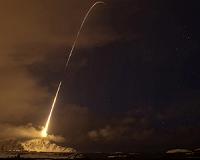 Experiment Hurtled Into Aurora Above Norway By NASA Rocket
Durham NH (SPX) Dec 17, 2010 A team of scientists led by Marc Lessard of the University of New Hampshire Space Science Center launched an instrument-laden, four-stage sounding rocket from Norway's Andoya Rocket Range into aurora about 200 miles above Earth early Sunday morning (Dec. 12, 2010), just before the two-week launch window slammed shut. For the 10-minute flight, a 65-foot-long Black Brant XII rocket arced thr ... read more |
|
|
| The content herein, unless otherwise known to be public domain, are Copyright 1995-2010 - SpaceDaily. AFP and UPI Wire Stories are copyright Agence France-Presse and United Press International. ESA Portal Reports are copyright European Space Agency. All NASA sourced material is public domain. Additional copyrights may apply in whole or part to other bona fide parties. Advertising does not imply endorsement,agreement or approval of any opinions, statements or information provided by SpaceDaily on any Web page published or hosted by SpaceDaily. Privacy Statement |


 del.icio.us
 Digg
Digg Reddit
 YahooMyWeb
 Google
 Facebook


