|
 |
 |
 |
 |
 |
 |
 |
 |

 |
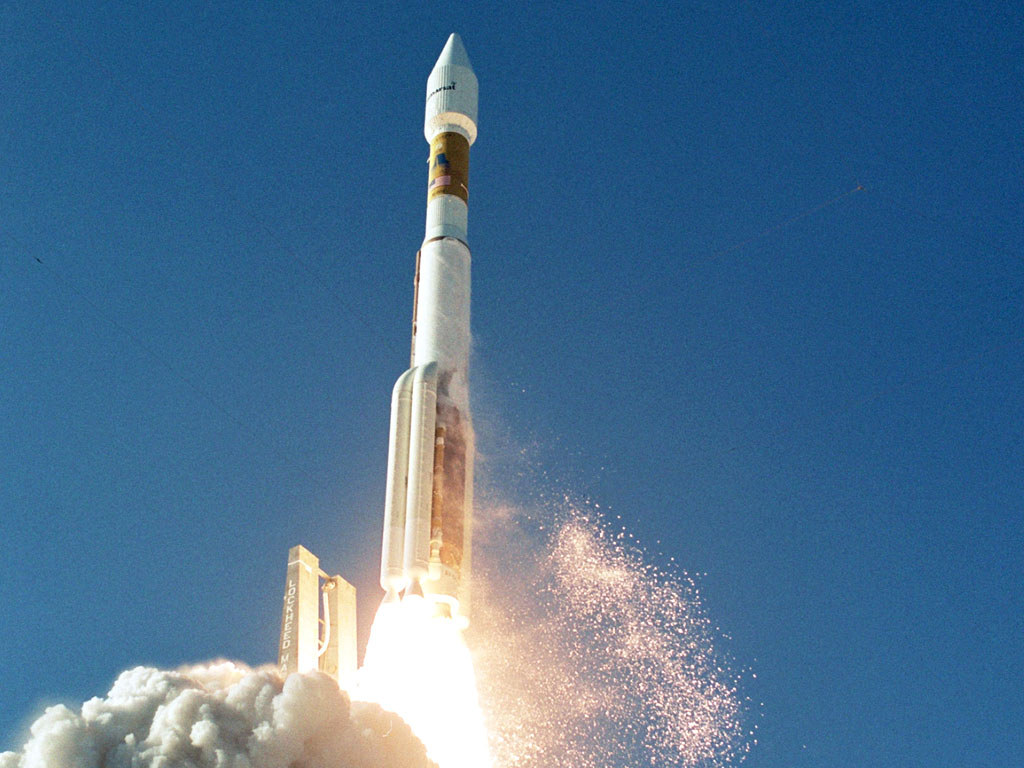
Atlas 5 Lifts Massive Satellite For Inmarsat
Cape Canaveral FL (SPX) Mar 11, 2005 An Atlas V launch vehicle carried its largest payload to date into orbit tonight, the Inmarsat 4-F1 satellite that weighs nearly 6 metric tons (5,959 kgs/13,138 pounds). This also marked the third launch of the year for International Launch Services (ILS). The Lockheed Martin-built Atlas V vehicle, designated AV-004, lifted off at 4:42 p.m. EST (21:42 GMT). It placed the Inmarsat spacecraft in a supersynchronous transfer orbit 32 minutes later. Satellite controllers have confirmed that the spacecraft is functioning properly. Tonight's vehicle used the Atlas V "431" configuration, meaning it had a 4-meter-diameter fairing, three solid rocket boosters (SRBs) and a single-engine Centaur upper stage. Atlas V vehicles have now flown five times, three of them with SRBs. "The Atlas series now has achieved an unprecedented string of 76 successful launches, and we're proud to count this mission and two others for Inmarsat among them," said ILS President Mark Albrecht. "This is a milestone launch for us, also, in terms of the size of the payload," Albrecht said. "Inmarsat 4-F1 is one of largest commercial communications satellites in the world, as well as the most massive satellite launched by Atlas. Yet it falls into the middle of the Atlas V capability range, demonstrating the flexibility of our design." The spacecraft is a Eurostar E3000 model built by EADS Astrium. It is the first in a generation of satellites that will support Inmarsat's new Broadband Global Area Network (BGAN), delivering internet and intranet content and solutions, video-on-demand, videoconferencing, fax, e-mail, phone and LAN access at speeds up to 432kbit/s almost anywhere in the world. BGAN will also be compatible with third-generation cellular systems. The operating location for Inmarsat 4-F1 is 65 degrees East longitude. "We thank ILS for the safe delivery of our first I-4 satellite into space," said Andrew Sukawaty, chairman and CEO of Inmarsat. "The first two I-4 satellites will bring broadband communications to 86 percent of the world. History has been made and the world has become closer through advanced data communications." Antoine Bouvier, CEO of EADS Astrium, said: "This successful launch is a major event for EADS Astrium, as Inmarsat-4 is certainly one of the most sophisticated communications satellites ever built. We thank for this achievement International Launch Services, and Inmarsat for the confidence they had in EADS Astrium on this innovative and ambitious program." Community Email This Article Comment On This Article Related Links SpaceDaily Search SpaceDaily Subscribe To SpaceDaily Express Launch Pad at Space-Travel.com
 Soyuz To Launch Radarsat-2
 Evry, France (SPX) Jan 11, 2006
Starsem announced Monday the signing of a contract with MacDonald, Dettwiler and Associates (MDA) for the launch of MDA's RADARSAT-2 Earth observation satellite by a Soyuz launch vehicle. |
|
|

| The content herein, unless otherwise known to be public domain, are Copyright 1995-2006 - SpaceDaily.AFP and UPI Wire Stories are copyright Agence France-Presse and United Press International. ESA PortalReports are copyright European Space Agency. All NASA sourced material is public domain. Additionalcopyrights may apply in whole or part to other bona fide parties. Advertising does not imply endorsement,agreement or approval of any opinions, statements or information provided by SpaceDaily on any Web page published or hosted by SpaceDaily. Privacy Statement |