|
 |
 |
 |
 |
 |
 |
 |
 |

 |
Astronomers Weigh 200-Million-Year-Old Baby Galaxies
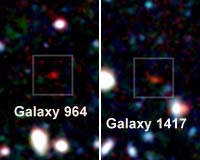
Pasadena CA (SPX) Oct 27, 2006 Astronomers have taken amazing pictures of two of the most distant galaxies ever seen. The ultradeep images, taken at infrared wavelengths, confirm for the first time that these celestial cherubs are real. The researchers are now able to weigh galaxies and determine their age at earlier times than ever before, providing important clues about the evolutionary origins of galaxies like our Milky Way. The work appears in the October 1 issue of Astrophysical Journal Letters. Carnegie Fellow Ivo Labbe, along with Rychard Bouwens and Garth Illingworth of the UCO/Lick Observatory at the University of California, Santa Cruz, and Marijn Franx of the Leiden Observatory, examined galaxies in the Hubble Ultra Deep Field (HUDF) using the sensitive Infrared Array Camera (IRAC) aboard NASA's Spitzer Space Telescope. The HUDF, scanned by NASA's Hubble Space Telescope in late 2003, remains the deepest view ever taken at visible and near-infrared wavelengths. The two galaxies are seen when the universe was just a baby - 700 million years after the Big Bang, or five percent of the universe's current age. They belong to a precious small sample of similarly ancient galaxies, discovered two years ago by Bouwens, Illingworth, and Franx and analyzed in-depth in Nature last month. The relative deficit of such far-away luminous sources indicates that this early period is when galaxies were rapidly building up from a very small number of stars to the massive galaxies we see at later times. Because there are so few of them, verifying the existence of the distant galaxies and measuring their properties is of paramount importance. The new mid-infrared observations from Spitzer proved essential for Labb�'s team, as the analyses were not possible from the Hubble data alone. "Spitzer is an amazing little machine," Labbe said. "It is a remarkable achievement that a small 0.85-meter telescope can see sources 12.7 billion light years away." Though astronomers have observed faraway galaxies before, these are the most distant for which detailed physical characteristics have been calculated. "I am certain that we would not have been able to confirm the existence of these galaxies, let alone calculate their stellar mass and age, without Spitzer," Labbe added. The two galaxies were between 50 and 300 million years old-infants themselves, by galactic standards-and weighed about one hundred times less than our full-grown Milky Way. The ages and masses suggest they were already in place much earlier, around 500-600 million years after the Big Bang. They could be among the first galactic systems formed in the universe, shortly after the first stars, meaning that future surveys might reveal luminous galaxies at even earlier times than those measured by Labbe and his colleagues. The first 500 million years after the Big Bang is known to astronomers as "The Dark Ages," because the universe was filled with clouds of neutral Hydrogen gas that obscured galaxies from our view. Astronomers theorize that newly formed galaxies began to emit enough radiation to burn through the cosmic fog, transforming the universe first into a billowing froth of plasma, and eventually into the transparent state it is today. The team investigated whether star formation in the galaxies could have been responsible for clearing this haze, but their calculations suggested that the galaxies in this study are too small and too few. Bouwens said, "In all probability, many more galaxies exist at these early times, but they are fainter than we can see with current telescopes." Help is on the way. New powerful instruments are to be installed on Hubble next year, and the next decade will mark the rise of the next generation of telescopes, such as the James Webb Space Telescope and planned 30-meter-class ground-based telescopes. Therefore Labbe remains optimistic. "I suspect the HUDF has many more secrets to divulge. With the new instruments and telescopes, we should be able to pry many more discoveries from this relatively tiny sliver of the heavens." This work is based on observations made with NASA's Spitzer Space Telescope, the NASA/ESA Hubble Space Telescope, and the European Southern Observatory in Paranal, Chile. The project team consists of Ivo Labbe (Carnegie Observatories), Rychard Bouwens and Garth Illingworth (University of California, Santa Cruz), and Marijn Franx (Leiden Observatory). Community Email This Article Comment On This Article Related Links First Galaxies Carnegie Institution of Washington Spitzer at Caltch Stellar Chemistry, The Universe And All Within It Stellar Chemistry, The Universe And All Within It
 Latest Views Of The V838 Monocerotis Light Echo From Hubble
 Baltimore MD (SPX) Oct 27, 2006
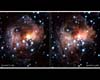
26-October-2006 Hubble has returned to the intriguing V838 Monocerotis many times since its initial outburst in 2002 to follow the evolution of its light echo. Two new images provide the most astonishing views of V838 to date. |
|
|

| The content herein, unless otherwise known to be public domain, are Copyright 1995-2006 - SpaceDaily.AFP and UPI Wire Stories are copyright Agence France-Presse and United Press International. ESA PortalReports are copyright European Space Agency. All NASA sourced material is public domain. Additionalcopyrights may apply in whole or part to other bona fide parties. Advertising does not imply endorsement,agreement or approval of any opinions, statements or information provided by SpaceDaily on any Web page published or hosted by SpaceDaily. Privacy Statement |