|
 |
 |
 |
 |
 |
 |
 |
 |

 |
Astronauts Stow Stubborn Solar Array
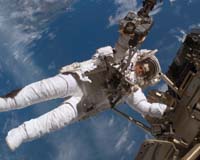
Houston TX (AFP) Dec 18, 2006 Two astronauts finally unstuck a balky solar array on the International Space station, folding the panel into its box during a special spacewalk Monday. In his record-breaking fourth spacewalk on a single mission, Robert Curbeam, together with Sweden's Christer Fuglesang, made one last try at forcing the array, which should fold up like a roadmap but became stuck on Wednesday. "The solar array has been fully retracted," Nicole Cloutier, the official commentator on NASA television said, to applause at mission control here. The spacewalk, for which NASA has lengthened the Discovery mission by a day, followed several days of attempts to shake loose the array, which supplies power to the ISS but has been replaced with new solar panel assemblies. Besides shaking, tugging and pushing on the array from inside and outside the ISS, on Friday NASA engineers in Houston asked German astronaut Thomas Reiter to exercise vigorously for 30 seconds on the ISS's training machine, hoping his vibrations would loosen the stuck array panels. Reiter, who is at the end of a five-month stay on the ISS, tried several times to shake the array into action but was unsuccessful. On a spacewalk Saturday, the astronauts completed a delicate rewiring of the space station but were again unable to fix the jammed array. That led to a decision to add one more walk to the schedule, and to extend the entire Discovery mission by one day. The decision to delay the landing originally planned for Thursday would halve the shuttle's two-day safety cushion for return to Earth. Discovery will only have one day's supply of oxygen and electrical power left, requiring a landing by Saturday at the latest. During Monday's spacewalk, Curbeam and Fuglesang, who represents the European Space Agency on the mission, were to make use of several tools, including a scraper and a hook for the wire that guides the folding of the array, which powers the ISS. The astronauts were authorized to pull guide wires, push panel hinges and, if necessary, shake the array to free it. The mission marked the first-ever spacewalks on consecutive days. There was little opportunity to enjoy the spectacular view of Earth, as the astronauts faced the threat of their space suits being pierced with micro-meteorites. They also had to be extremely careful not to damage the sensitive panels. The panel was folded away as a new set of solar panels are activated to tap the sun's rays for electricity for the space station. The station, when completed, will have a total of four solar arrays providing it with electricity. Including the current Discovery mission, NASA has planned 14 shuttle flights to complete the ISS by 2010, when the shuttle fleet, down to three vehicles, is to be retired. Discovery and its seven-member crew blasted off last Saturday from Cape Canaveral, Florida, in the first nighttime liftoff in four years.
Source: Agence France-Presse Community Email This Article Comment On This Article Related Links STS-116 Podcasts STS-116 Mission Space Shuttle News at Space-Travel.Com Space Shuttle News at Space-Travel.Com
 Canadian Experiment Aboard Space Shuttle Discovery
 Longueuil, Canada (SPX) Dec 14, 2006
A unique Canadian experiment on hand-eye coordination capacity of astronauts in microgravity was done yesterday aboard space shuttle Discovery. York University's Dr. Barry Fowler led this experiment funded by the Canadian Space Agency (CSA). Space shuttle pilots and payload operators need quick and accurate hand-eye coordination to manoeuvre objects in space. To dock the shuttle safely to the International Space Station, for example, the pilot must be accurate within a few centimetres while both vehicles move through space at 30,000 km per hour. |
|
|

| The content herein, unless otherwise known to be public domain, are Copyright 1995-2006 - SpaceDaily.AFP and UPI Wire Stories are copyright Agence France-Presse and United Press International. ESA PortalReports are copyright European Space Agency. All NASA sourced material is public domain. Additionalcopyrights may apply in whole or part to other bona fide parties. Advertising does not imply endorsement,agreement or approval of any opinions, statements or information provided by SpaceDaily on any Web page published or hosted by SpaceDaily. Privacy Statement |