|
 |
 |
 |
 |
 |
 |
 |
 |

 |
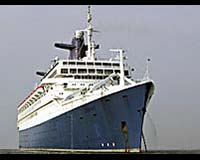
Asbestos-Laden Ship Cannot Be Broken Up Says Indian Court
New Delhi (AFP) Dec 04, 2006 India's Supreme Court Monday ruled that an asbestos-laden cruise liner, the Blue Lady, could not be dismantled at a ship breaking yard in western India without its permission, a report said. "There will be no dismantling of the ship without the leave of this court," said the ruling by Justice Arijit Pasayat and Justice S H Kapadia, the Press Trust of India reported. The controversial former French-owned ship, which is now owned by Indian shipbreakers, contains 1,200 tonnes of harmful polychlorinated biphenyls and carcinogenic asbestos and should not be broken up at Alang, environmental groups have claimed. The court also directed the state-run pollution control board in western Gujarat state to outline plans to dismantle the ship within a month and to find out whether the ship could be sent back to its French owners. Monday's ruling came after a Supreme Court committee report in September said one in six workers at the world's biggest shipbreaking yard at Alang showed symptoms of the fatal illness asbestosis, an incurable disease caused by exposure to asbestos that destroys the lungs and eventually proves fatal. The Supreme Court had been waiting for the report to help decide the fate of the cruise ship sold by its French owners in 1979 and now named the Blue Lady. The workers examined in the study had been engaged in removing asbestos from ship insulation linings. The Blue Lady is currently beached about 4,000 feet (1,200 meters) off the Alang coast, some 200 kilometers (160 miles) northwest of India's financial centre Mumbai. An international coalition of environmental, human and labour rights groups Monday welcomed the Supreme Court ruling. "It is well known that Alang does not have the facilities to properly manage hazardous materials such as asbestos and oil residues," said the statement jointly issued by Green Peace, the Basel Action Network, Ban Asbestos Network India and other groups. Most seagoing ships end their lives at shipyards in India, Bangladesh, China and Pakistan. For major industrialised nations, safety and environmental laws make shipbreaking work hugely costly. But in the developing world, lax enforcement of safety and environmental rules and a vast supply of cheap labour can make shipbreaking a profitable proposition. Last year, France recalled the decommissioned warship Clemenceau after a battle by environmentalists who said it contained between 500 to 1,000 tonnes of asbestos. France said the ship only contained 45 tonnes of the material.
Source: Agence France-Presse Community Email This Article Comment On This Article Related Links Supreme Court Of India Our Polluted World and Cleaning It Up Our Polluted World and Cleaning It Up
 Reducing Air Pollution Could Increase Rice Harvests In India
 Berkeley CA (SPX) Dec 05, 2006
New research from the University of California indicates that reductions of human-generated air pollution could create unexpected agricultural benefits in one of the world's poorest regions. These new findings will be published online the week of Dec. 4 in the journal Proceedings of the National Academy of Sciences (PNAS). |
|
|

| The content herein, unless otherwise known to be public domain, are Copyright 1995-2006 - SpaceDaily.AFP and UPI Wire Stories are copyright Agence France-Presse and United Press International. ESA PortalReports are copyright European Space Agency. All NASA sourced material is public domain. Additionalcopyrights may apply in whole or part to other bona fide parties. Advertising does not imply endorsement,agreement or approval of any opinions, statements or information provided by SpaceDaily on any Web page published or hosted by SpaceDaily. Privacy Statement |