|
 |
 |
 |
 |
 |
 |
 |
 |

 |
Antarctica's Coldest, Darkest Season Draws MSU Researchers
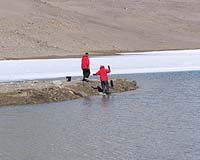
Bozeman MT (SPX) Mar 11, 2008 John Priscu normally works in Antarctica during its warmest and longest days. He usually shares the continent with scientists from all over the world. This year is different. The Montana State University scientist with an international reputation for polar research is spending his 24th season in Antarctica with no other researchers except the 17 members of his team. They're there for 2 1/2 months at the beginning of the coldest and darkest part of the year. During Antarctica's winter -- also called the "Polar Night" -- daylight disappears completely and temperatures can reach minus-55 degrees F. He was looking forward to it, Priscu said before leaving Bozeman in January. He had been planning the trip for nine years and said it is vital. He wants to get a more complete picture of what's happening in the lakes and liquid water that exist under Antarctica's glaciers, Priscu said. That's why he asked the National Science Foundation, which funds his research, if he could go at a different time of year. Spending a couple of months in Antarctica at the same time every year for decades is invaluable, but not good enough. "Antarctica doesn't stop in the winter," Priscu said. Priscu's team is working on several research projects, one of which is aimed at better understanding how microorganisms adapt to the loss of light. The researchers know that microbes stop converting sunlight into energy and start consuming organic carbon in the dark, but they want to learn more. The answers relate to global warming and carbon balance, Priscu said. Priscu typically goes to Antarctica in October and returns in December. This year, he and Barbara Vaughn left Bozeman on Jan. 29 to get married in New Zealand. After their Feb. 5 wedding and a week-long honeymoon, Vaughn returned to Bozeman and Priscu continued on to Antarctica to join some of his team members already in Antarctica. This year's team includes former MSU students, as well as graduate students and postgraduate students from England, Scotland and Canada. Two members are undergraduate students. Eighty percent of the team is women. One team member is Amy Chiuchiolo, an MSU research associate who has traveled to Antarctica six times in the past. Her latest trip ended right before Christmas. "It's hard to go away every year for a couple of months, but it's fun," she said. "You can't beat doing field work." The NSF supplies "extreme cold weather gear," which includes red parkas, hats, mittens, gloves and snow pants, Chiuchiolo said. She added that gloves get "pretty trashed" while drilling holes through 12 to 15 feet of ice to collect samples. Priscu said his team members flew through New Zealand to Antarctica where they landed in a C-17 military transport airplane on a glacier about an hour away from McMurdo Station, the largest community in Antarctica. Large-tracked vehicles then took them to McMurdo where approximately 500 people provide support services. To collect and process samples, the team members fly by helicopter to field stations near the lakes in the McMurdo Dry Valleys, Transantarctic Mountains. The field stations have one building where the researchers work with their samples, Priscu said. Diesel generators supply electricity. The researchers sleep in tents. To move around camp, they wear headlamps or carry flashlights when the auroras and the moon are not supplying light. "I have never had to turn a light on before in the field camp," Chiuchiolo said. The sun shines 24 hours a day during the height of an Antarctic summer. If conditions allow, the entire team will leave Antarctica on April 17, Priscu said. Priscu, 55, said he doesn't expect to return to Antarctica for another Polar Night. This one alone took almost a decade of planning. "This is not an old man's game," he said. He does plan to return as usual during the Antarctic summers. Community Email This Article Comment On This Article Related Links Montana State University Beyond the Ice Age
 Rock Studies Help Crack Questions Of Glacier Thinning In West Antarctica
 London, UK (SPX) Feb 29, 2008
Boulders the size footballs could help scientists predict the West Antarctic Ice Sheet's (WAIS) contribution to sea-level rise according to new research published this week in the journal Geology. |
|
|

| The content herein, unless otherwise known to be public domain, are Copyright 1995-2007 - SpaceDaily.AFP and UPI Wire Stories are copyright Agence France-Presse and United Press International. ESA Portal Reports are copyright European Space Agency. All NASA sourced material is public domain. Additional copyrights may apply in whole or part to other bona fide parties. Advertising does not imply endorsement,agreement or approval of any opinions, statements or information provided by SpaceDaily on any Web page published or hosted by SpaceDaily. Privacy Statement |