|
 |
 |
 |
 |
 |
 |
 |
 |

 |
Antarctic Ice Loss
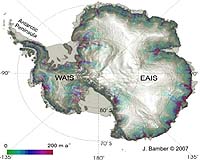
Bristol, UK (SPX) Jan 14, 2008 Increasing amounts of ice mass have been lost from West Antarctica and the Antarctic peninsula over the past ten years, according to research from the University of Bristol and published online this week in Nature Geoscience. Meanwhile the ice mass in East Antarctica has been roughly stable, with neither loss nor accumulation over the past decade. Professor Jonathan Bamber at the University of Bristol and colleagues estimated the flux of ice from the ice sheet into the ocean from satellite data that cover 85% of Antarctica's coastline, which they compared with simulations of snow accumulation over the same period, obtained using a regional climate model. They arrived at a best estimate of a loss of 132 billion tonnes of ice in 2006 from West Antarctica - up from about 83 billion tonnes in 1996 - and a loss of about 60 billion tonnes in 2006 from the Antarctic Peninsula. Professor Bamber said: "To put these figures into perspective, four billion tons of ice is enough to provide drinking water for the whole of the UK population for one year." The authors conclude that the Antarctic ice sheet mass budget is more complex than indicated by the evolution of its surface mass balance or climate-driven predictions. Changes in glacier dynamics are significant and may in fact dominate the ice sheet mass budget. This conclusion is contrary to model simulations of the response of the ice sheet to future climate change, which conclude that it will grow due to increased snowfall. The ice loss is concentrated at narrow glacier outlets with accelerating ice flow, which suggests that glacier flow has altered the mass balance of the entire ice sheet. Over the 10 year time period of the survey, the ice sheet as a whole was certainly losing mass, and the mass loss increased by 75% during this time. Most of the mass loss is from the Amundsen Sea sector of West Antarctica and the northern tip of the Peninsula where it is driven by ongoing, pronounced glacier acceleration. In East Antarctica, the mass balance is near zero, but the thinning of its potentially vulnerable marine sectors suggests this may change in the near future. Community Email This Article Comment On This Article Related Links Beyond the Ice Age
 Highest Antarctic icecap peak reached
  Beijing (UPI) Jan 12, 2008
 A Chinese team culminated a 21-day quest to scale the highest peak on the Antarctic icecap Saturday when the 17 scientists reached the top of Dome A. |
|
|

| The content herein, unless otherwise known to be public domain, are Copyright 1995-2007 - SpaceDaily.AFP and UPI Wire Stories are copyright Agence France-Presse and United Press International. ESA Portal Reports are copyright European Space Agency. All NASA sourced material is public domain. Additional copyrights may apply in whole or part to other bona fide parties. Advertising does not imply endorsement,agreement or approval of any opinions, statements or information provided by SpaceDaily on any Web page published or hosted by SpaceDaily. Privacy Statement |