|
 |
 |
 |
 |
 |
 |
 |
 |

 |
Ziyuan-2B Launch Leaves Family Hefty Medical Bill
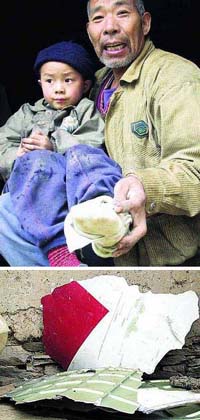
Beijing - Nov 06, 2002 Rocket debris from the recent launch of the Ziyuan-2B remote sensing satellite has left a child in rehabilitation and his family an expensive medical payment. Beijing Youth Daily on Monday (Nov. 4) published an account of the post-launch mishap. Detailed report of property damage or personal injury from a space launch has rarely, if ever, been made public. Ziyuan-2B (ZY-2B, "Ziyuan" means resource) went into space aboard a Changzheng-4B (Long March-4B) launcher, which lifted off from the Taiyuan Satellite Launching Center (TSLC) in the northern Shanxi Province at 11:17 a.m. Beijing Time (0317 UTC) on Oct. 27. The Earth observing satellite separated from the launcher about 12 minutes after the liftoff and successfully reached its sun-synchronous polar orbit. Other than the initial report from the China News Services that ZY-2B was functioning nominally, there was no further news about the current status of the mission. The accident happened in the Yanghe village near the city of Shangluo. The city is in the southeast corner of the Shaanxi Province, about 600 km downrange southwest of the launch site that is located in the neighbouring province. Beijing Youth Daily reported that villager Wu Fusheng was preserving persimmons in his yard the morning of the CZ-4B launch. His 6-year-old son Wu Jie was playing with neighbouring kids under a persimmon tree outside the yard. Suddenly the senior Wu heard two successive huge explosions that came from the sky over the distant valley. Wu recalled that he saw a white smoke trail in the sky after hearing the explosion. Several minutes later he saw an object falling very fast from the sky at an angle. The unknown object hit the tree where his son and the other children were. The object took a tumble, then struck the head, shoulder and left foot of the junior Wu. The boy fell to the ground and cried in pain. Wu Jie was very fortunate to escape a serious injury. The debris caused bleeding on his left foot, and broke the little toe and scraped its toenail. The little Wu also had a contusion on his head. In a medical system which would require upfront payment before treatment became available, Wu had to foot more than $400 renminbi ($48 U.S.) to get his son medical care in the local hospital. The amount is about the average monthly salary in China. Wu said, "The money had to be borrowed from neighbours." When the twin sonic booms shook the village, the Chief of the village Zhang Zhifu ran to the top of the hill to investigate. He also saw white smoke in the sky and smelled gunpowder in the air. Chief Zhang thought that there was an airplane crash. Zhang ran back to the village to alert the residents. The population of 976 in 271 families is scattered throughout the more than 20 km wide hilly area. Many villagers also saw metallic debris raining from the sky. Wu said that the piece of metal that struck his son looked like aluminium. The debris is approximately 80 cm long and 50 cm wide, and weighs about 20 kg. His fellow villager Wu Jinchao carried a piece of curved debris home on his back when he returned from picking persimmons. He found the nearly 70 kg metal on the hill. Altogether 19 pieces of debris are found to date. But many pieces likely remain in the field. After the debris shower happened, Chief Zhang reported the incident to the town administration. Town police and armed forces arrived in the afternoon to investigate and register all the recovered debris. The debris was temporarily stored at the homes of the villagers for further higher level investigation. Villagers had raised concern whether the debris might pose a health risk. Upon further query with space officials, the local investigation team told villagers that the debris came from the CZ-4B launch and there was no need to worry about risk to human health. Space officials explained that according to the launch plan, debris from the CZ-4B rocket should have fallen in the designated impact zone in the mountainous area of Shanyang County to the west of the village. Officials speculated that changing atmospheric conditions might have caused some of the debris to land further east and ended up in the Yanghe village. As to the medical expenses that Wu had to shell out, the town administration had submitted a report to the county asking for reimbursement and additional compensation. Community Email This Article Comment On This Article Related Links SpaceDaily Search SpaceDaily Subscribe To SpaceDaily Express The Chinese Space Program - News, Policy and Technology China News from SinoDaily.com
 Taikonauts On Moon A Far Off Dream For China Yet
 Beijing (XNA) Jan 05, 2006
A one-year lunar fly-by mission may start in April 2007 in China, but a manned flight to the Earth's neighbour may be a long way away, a chief lunar exploration scientist said last night. |
|
|

| The content herein, unless otherwise known to be public domain, are Copyright 1995-2006 - SpaceDaily.AFP and UPI Wire Stories are copyright Agence France-Presse and United Press International. ESA PortalReports are copyright European Space Agency. All NASA sourced material is public domain. Additionalcopyrights may apply in whole or part to other bona fide parties. Advertising does not imply endorsement,agreement or approval of any opinions, statements or information provided by SpaceDaily on any Web page published or hosted by SpaceDaily. Privacy Statement |