|
 |
 |
 |
 |
 |
 |
 |
 |

 |
X-43 Gets A Windy Work Out
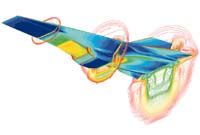
Edwards - February 14, 2000 - NASA's X-43A hypersonic air-breathing vehicle recently underwent controlled radio frequency testing at Edwards Air Force Base, Edwards, Calif., in the Benefield Anechoic Facility (BAF). Housed in the BAF is the anechoic chamber, a building within a building. Anechoic chambers are specialized facilities that provide an electromagnetically controlled test environment. The chamber provides isolation from outside radio frequencies, therefore maximizing measurement fidelity and precision. Measuring 264 x 250 x 70 feet, the BAF's anechoic chamber is the largest in the world, capable of testing planes as big as the B-52 and C-17. Hanging by one of two 40-ton hoists, the 12-foot-long X-43A was the smallest vehicle ever tested in the BAF. The X-43A tests measured the S-band telemetry transmitter and C-band transponder antennas to determine if the antennas send and receive signals and information properly. Built by MicroCraft Inc., Tullahoma, Tenn., for NASA's Hyper-X program, the unpiloted X-43A vehicles will significantly expand the boundaries of air-breathing aircraft. Three flights are planned -- two at Mach 7 and one at Mach 10. The flight tests will be conducted within the Western Test Range off the coast of Southern California. The Hyper-X program will build a technology bridge to reusable and recoverable vehicles with larger engines. Program managers hope to demonstrate hydrogen-powered, air-breathing propulsion systems that could ultimately be applied to vehicles including hypersonic aircraft and reusable space launchers. The X-43A project is limited to three actual flights with vehicles that cannot be reused. This makes advance ground testing of the X-43A imperative. The BAF can accommodate these tests in a controlled environment, free from stray electronic signals. These advantages can cut costs in an overall program and obtain data in the early stages of test programs by resolving systems complications before test flights on a range begin. The facility has been used to test a wide variety of aircraft and avionics such as radar warning receivers, weapon control systems and electronic countermeasure pods. A completely successful mission for each of the three X-43A aircraft depends on four basic events occurring for each flight:
"Understanding the telemetry pattern that emanates from the vehicle is absolutely critical to the Hyper-X flight program," said John Kelly, lead systems engineer on the X-43A flight project. "Through use of the Benefield Anechoic Facility, we were able to test the X-43A in a radio free environment and accurately identify the telemetry patterns of the vehicle. We will be using this data to help define the flight track and to position the Navy airborne support aircraft (P-3s) that will be receiving the TM telemetry stream from the X-43," added Kelly.
Email This Article Comment On This Article Related Links Space
 Satellite Launch To Boost DTH In India
 Calcutta, India (SPX) Dec 28, 2005
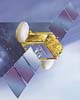
The successful launch Thursday of India's heaviest satellite from spaceport of Kourou in French Guyana may have boosted the country's space research efforts to yet another level, but it has also lifted the spirits of at least three Direct-To-Home televisions broadcasters, one of which has been waiting for years to launch its services in India. |
|
|

|
|
|
|
|
|
|
|
|
|
|
|
| The content herein, unless otherwise known to be public domain, are Copyright 1995-2006 - SpaceDaily.AFP and UPI Wire Stories are copyright Agence France-Presse and United Press International. ESA PortalReports are copyright European Space Agency. All NASA sourced material is public domain. Additionalcopyrights may apply in whole or part to other bona fide parties. Advertising does not imply endorsement,agreement or approval of any opinions, statements or information provided by SpaceDaily on any Web page published or hosted by SpaceDaily. Privacy Statement |