|
 |
 |
 |
 |
 |
 |
 |
 |

 |
X-33 L-Ox Tank Completes Stress Tests
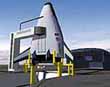
Huntsville - May 10, 1999 - Tests conducted by NASA's Marshall Space Flight Center show the experimental X-33 technology demonstrator's liquid oxygen tank is ready for sub-orbital trips at more than 13 times the speed of sound. "The tests went very well," said Phil Best, propulsion chief engineer at the Marshall Center in Huntsville, Ala. "All the collected data from the tests matched our predictions." Gene Austin, NASA's X-33 program manager, said the completed test series "adds to our overall confidence in the vehicle as we keep pushing toward final assembly and its first flight next year." The two-week test on the aluminum liquid oxygen tank at the Marshall Center simulated conditions the X-33 will experience during pre-takeoff, takeoff, ascent, return and landing stages. NASA engineers applied internal pressure and external loads to the duplicate 6,000-pound aluminum tank, which is identical to the actual flight tank that was installed in X-33 and will eventually hold 181,000 pounds of liquid oxygen. "With this tank, we not only validated a component, but we've also scored another success in this fast-paced technology development and demonstration program," said Cleon Lacefield, Lockheed Martin Skunk Works vice president for X-33/VentureStar. The X-33 is being developed under a cooperative agreement between NASA and Lockheed Martin Skunk Works in Palmdale, Calif. Lockheed's Michoud Space Systems in New Orleans designed and built both the test tank and the flight tank. "Thanks to our combined knowledge on aluminum cryogenic tanks," Lacefield said, "we recognized we could install the flight tank while validating its exact duplicate at Marshall. This has allowed us to complete major tasks in a condensed period of time." "After being cleaned, X-rayed and insulated at Marshall, the test tank will be shipped to NASA's Glenn Research Center in Cleveland, where it will be used, because of its size, in subcooled liquid oxygen and liquid hydrogen tests complementary to the X-33 program. Designed as a key X-33 structural element, the liquid oxygen tank is the technology demonstrator's second major element declared fit for flight this year. In February, metallic thermal-protection system panels also passed an intensive test series. The X-33, a half-scale technology demonstrator of the Lockheed Martin commercial reusable launch vehicle dubbed VentureStar, is scheduled to begin flight tests in mid-2000. The X-33 is being developed to demonstrate advanced technologies that will dramatically increase launch vehicle reliability and lower the cost of putting a pound of payload into space from $10,000 to $1,000.
Reuseable Launch Vehicle Archive at Spacer.Com
X-3X Rotary Kistler Other Space Planes General RLV Industry Issues Email This Article Comment On This Article Related Links Space
 Satellite Launch To Boost DTH In India
 Calcutta, India (SPX) Dec 28, 2005
The successful launch Thursday of India's heaviest satellite from spaceport of Kourou in French Guyana may have boosted the country's space research efforts to yet another level, but it has also lifted the spirits of at least three Direct-To-Home televisions broadcasters, one of which has been waiting for years to launch its services in India. |
|
|

|
|
|
|
|
|
|
|
|
|
|
|
| The content herein, unless otherwise known to be public domain, are Copyright 1995-2006 - SpaceDaily.AFP and UPI Wire Stories are copyright Agence France-Presse and United Press International. ESA PortalReports are copyright European Space Agency. All NASA sourced material is public domain. Additionalcopyrights may apply in whole or part to other bona fide parties. Advertising does not imply endorsement,agreement or approval of any opinions, statements or information provided by SpaceDaily on any Web page published or hosted by SpaceDaily. Privacy Statement |