|
 |
 |
 |
 |
 |
 |
 |
 |

 |
X-33 Aims For Vehicle Rollout Q1 2000
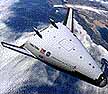
Huntsville - September 28, 1999 - The X-33 program is in the midst of final testing and validation of key components and is aiming for vehicle rollout by Q1 2000. Currently, the first of two composite liquid hydrogen tanks and the first of four aerospike engines have entered validation testing. Once testing is complete, these components will be shipped to the Lockheed Martin Skunk Works in Palmdale for installation on the X-33. The X-33 is scheduled to begin flight tests in the summer of 2000. Meanwhile engine test team is scheduled to test fire the first of four linear aerospike engines being built for the X-33 at NASA's Stennis Space Center, Miss., this week. The first engine firing, which will last less than five seconds, is part of a series of 41 test firings on four engines. Two of the engines have been designated as test engines, while two will be used as flight engines on the X-33. The engine undergoing tests is the first test engine. The first six tests on engine No. 1 address engine ignition and start sequence development. Each test is planned to last five seconds or less. Once these tests are complete, Stennis crews will conduct eight additional tests, each running no more than 250 seconds. These longer tests will be used to verify engine performance at various mixture ratios and power levels, as well as demonstrate thrust vector control or steering. Planned total test duration on the first test engine is 1,142 seconds. Once the first engine has been successfully tested, two flight engines will be tested in 11 runs for a total of 1,042 seconds. After successfully completing the single-engine tests on the two flight engines in late 1999, the engines will be shipped to the Skunk Works to be mounted on the X-33. Beginning in January 2000, the two test engines will be placed on the test stand together in a dual-engine arrangement to mimic the flight configuration, and the two will undergo 16 test firings for a total of 2,646 seconds. The linear aerospike engines are being built by X-33 industry partner Boeing Rocketdyne. Liquid Hydrogen Fuel Tank Tests A series of pressure and stress tests has begun on X-33's right-hand composite liquid hydrogen fuel tank at NASA's Marshall Space Flight Center in Huntsville, Ala. The 29-foot, 4,600-pound graphite epoxy tank is designed to carry approximately 29,000 gallons of liquid hydrogen rocket fuel. The right-hand hydrogen tank, along with its twin left-hand tank, form the flanks of the X-33 and comprise roughly half its airframe. Engineers at NASA Marshall conducted the second pressure test on the composite tank by filling it completely with liquid hydrogen at -423 degrees Fahrenheit Sept. 21. One of the objectives of the test was to pinpoint seepage areas on the composite tank. When the tank was pressurized to 20 psi, as expected, some hydrogen seepage was noted. Technicians are applying sealant or patchwork to affected areas before resuming pressure tests. The tank passed an earlier pressure test with liquid nitrogen and a 5 psi helium leak test after it was shipped to Marshall. Similar patchwork was completed on the X-33's earlier 5-foot composite test tank or the "Double D" tank. The 5-foot tank has since successfully completed approximately 30 cryogenic cycles involving the filling, draining and filling again of liquid hydrogen at pressure. To fully validate the flight tank, six pressure and combined pressure and structural loads tests will be conducted over the next few weeks. Once validated, the tank will be shipped to the Skunk Works for installation into the X-33. The left-hand liquid hydrogen tank has completed assembly at Lockheed Martin Missiles and Space, Sunnyvale, Calif., and awaits transfer to Marshall in early October for its test series. Alliant Techsystems, Clearfield, Utah, fabricated components for the tanks, while a joint Lockheed Martin-Alliant team working in Sunnyvale completed the assembly. Umbilicals Tested, Installed and Tested The launch umbilicals -- which will connect the X-33 to the cryogenic gas, power and computer lines while the vehicle sits on its launch mount -- have completed testing at NASA Kennedy Space Center, Fla., and have been installed on the vehicle assembly. The vehicle's two 3-foot by 4-foot aluminum interface panels were installed on the aft section of the vehicle assembly in August, while two 15-foot-tall carbon steel tunnels that will house the launch mount's version of the interface panels were installed shortly thereafter. Just like a car needs a pump, hose and nozzle to fill its gas tank, the X-33 requires a complex system of panels, valves and hoses -- known as umbilicals -- to transfer its super-cold propellants from on-site tank farms, through the launch mount, and into the vehicle's internal tanks. Carefully positioned latches and actuators are used to ensure all connections are properly aligned and sealed during vehicle fueling, and then quickly retracted and covered as the vehicle lifts off. Software Build Nears Completion About 90 percent of the software that will autonomously control the X-33 from take-off to landing has begun integration, while months of testing and independent verification remains. The software will eventually be loaded on the X-33's three redundant mission computers, allowing the vehicle to fly itself from takeoff at Edwards Air Force Base, Calif., to landing at Dugway Proving Ground, Utah, and later Malmstrom Air Force Base, Mont. The software also will give the Lockheed Martin-led operations team the ability to monitor the vehicle's flight from the program's eight-person control room at the Flight Operations Center at Edwards. Delivery is complete on five of the six segments of flight software. The final software segment -- which adds vehicle approach and landing to the current software -- is undergoing testing before delivery. Testing of this segment -- referred to as "Build No. 6" -- will be complete later this year. The entire software package will be put through its paces constantly until the start of flight testing to monitor accuracy and effectiveness. Industry partner AlliedSignal, Teterboro, N.J., created the software and is working with Lockheed Martin and NASA to test and integrate the software for the X-33. Avionics Bay In Place Installation of the X-33's avionics bay was completed Sept. 2 at the Skunk Works. The titanium avionics bay is 6 feet by 11 feet with an empty weight of approximately 300 pounds. The bay houses vehicle control systems such as the three redundant mission computers, communications gear, navigation equipment, and 28-volt and 270-volt power supplies. The bay sits in the center of the X-33 between the forward liquid oxygen tank and the vehicle's two liquid hydrogen tanks. It is positioned near the upper surface of the vehicle, directly below one of the vehicle's upper thermal blankets, to allow for easy access. This positioning allows for quick replacement of components, supporting one of the X-33 program's overall goals of demonstrating aircraft-like operations in a launch vehicle. Duplicate Liquid Oxygen Tank To Be Tested Testing will begin in November at Glenn Research Center, Cleveland, on a 6,000-pound aluminum liquid oxygen tank that is a duplicate of the tank previously installed in the X-33's assembly structure. The testing is designed to obtain data on a system designed to densify -- or further cool to make more dense -- cryogenic rocket fuels. The duplicate tank was built by Lockheed Martin Michoud Space Systems, New Orleans, and shipped to Glenn Research Center for loading into a test stand. Testing of the liquid oxygen tank is scheduled to be complete in December. By densifying cryogenic propellants, engineers hope to show that by further cooling the liquids, tanks will be able to hold a greater volume of cryogenic liquids, within the range of an additional 5 to 10 percent of volume. This process could greatly aid the design and eventual operations of a single-stage-to-orbit Reusable Launch Vehicle where weight and fuel carrying capacity is crucial. X-33 Flight Operations Center On Schedule The X-33 Flight Operations Center at Edwards is online and on schedule to support the X-33 vehicle arrival and flight test series, both scheduled to occur in 2000. Currently, all major ground system equipment has been installed at the launch pad area, and checkouts are being performed as software arrives.
Email This Article Comment On This Article Related Links Space
 Satellite Launch To Boost DTH In India
 Calcutta, India (SPX) Dec 28, 2005
The successful launch Thursday of India's heaviest satellite from spaceport of Kourou in French Guyana may have boosted the country's space research efforts to yet another level, but it has also lifted the spirits of at least three Direct-To-Home televisions broadcasters, one of which has been waiting for years to launch its services in India. |
|
|

|
|
|
|
|
|
|
|
|
|
|
|
| The content herein, unless otherwise known to be public domain, are Copyright 1995-2006 - SpaceDaily.AFP and UPI Wire Stories are copyright Agence France-Presse and United Press International. ESA PortalReports are copyright European Space Agency. All NASA sourced material is public domain. Additionalcopyrights may apply in whole or part to other bona fide parties. Advertising does not imply endorsement,agreement or approval of any opinions, statements or information provided by SpaceDaily on any Web page published or hosted by SpaceDaily. Privacy Statement |