|
 |
 |
 |
 |
 |
 |
 |
 |

 |
With US Shuttles In Drydock, Russia Has Monopoly On ISS Taxi Service
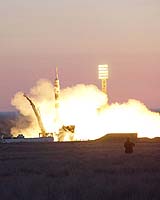
Moscow (AFP) Aug 21, 2005 The grounding of US space shuttles has left Russia with a temporary monopoly on manned flight to the International Space Station (ISS), and officials here are crowing that whatever their cosmic taxis lack in frills they make up for in high reliability and low cost. Mincing few words, space officials say Russia can make three manned flights to the ISS between now and February if needed, but make clear in the same breath they expect the United States to foot the bill for any missions made necessary by scrapping of planned shuttle flights. Their price? A cool 65 million dollars - a fraction of the more than 500 million-dollar pricetag for an average shuttle mission - according to Alexei Krasnov, head of the Russian Space Agency's manned spaceflight program. For that money, a paying customer would get a Soyuz rocket, the workhorse of Russian space transport, and all accompanying launch, mission supervision and return-trip services. "We hope that American shuttles will resume regular flights and we are offering our NASA colleagues the use of Soyuz as a rescue spaceship," Krasnov said Thursday at an aerospace trade exhibition outside Moscow, a trade show that underscored Russia's prowess in space exploration. Russian and US space officials were planning to sit down and hash things out in the coming weeks, taking into account the disruption to the US shuttle mission schedule, and Krasnov said Russia was prepared to consider a variety of scenarios. "Our counterparts from NASA will visit us late August or early September, and we will then discuss what services Russia can provide to deliver cargoes and crews, and on what terms," Krasnov said. Although China launched its first manned space mission in 2003 and is reported to be preparing for a second mission, possibly as early as October, Russia and the United States are still at present the only powers that ferry human cargo to the ISS. But NASA announced Thursday it was grounding its shuttle fleet until at least March following a mishap on the latest mission like that which doomed the Columbia orbiter in 2003, and some experts have speculated the US shuttles, central to the ISS project, could be mothballed for good. Even if US space officials conclude they need Russia's help in space, Russian officials said, they may find themselves constrained by US law itself, specifically an amendment that bars US financial involvement in Russian space projects due to Moscow's nuclear cooperation with Iran. Russia meanwhile is looking far beyond partnership with the United States for the future of its own manned space program, setting its sights on a range of state-funded and commercial projects -- including a plan to send a rich space tourist to orbit the moon. The country's draft 2006 budget allocates more than 6.1 billion rubles (around 220 million dollars) for the space program, a meagre sum compared to NASA's projected 9.6 billion-dollar 2006 budget, but nonetheless a whopping 160-percent increase on this year's Russian space budget. In addition to financing Russia's current space presence, some of those funds are earmarked for development of the country's own space shuttle, the Clipper, a reusable manned space vehicle that Russia plans to launch within 10 years. Like the US space shuttles, the Clipper is designed to carry people to and from space. Unlike the US space shuttle, it doesn't pretend to be of use for anything else and is therefore a fraction of the size, a fraction of the sophistication - and a fraction of the cost - of the US vessel. And while US space planners wring their hands about what to do next, Russian officials have been telegraphing steady reminders that their ISS contractual obligations to NASA expire next spring and that ferrying Americans to space will not necessarily be a priority for them after that. "Russia's obligations to its US partners will end in the spring," Krasnov said. "A Soyuz rocket will then take two Russian cosmonauts... to the ISS. The third place will be reserved either for a space tourist or for an astronaut from the European Space Agency." He also stressed that while Europe does not have manned space vehicles it is scheduled to launch its first ATV supply ship to the ISS early next year, signalling that international presence in space will henceforth be increasingly less reliant on the US program. A Russian Space Agency source quoted by Interfax news agency said earlier this month that ISS member states are planning to convene this autumn, possibly in Japan, to lay out future plans for the space station in light of uncertainties about the US role in the project. Community Email This Article Comment On This Article Related Links SpaceDaily Search SpaceDaily Subscribe To SpaceDaily Express Space Station News at Space-Travel.Com
 NASA Had No Choice But To Buy Soyuz Flights
 Washington DC (SPX) Jan 09, 2006
NASA's announcement last week that it will pay Roskosmos $43.6 million for a round-trip ride to the International Space Station this spring, and an equivalent figure for an as-yet-undetermined number of future flights to the station until 2012, represents the agency's acknowledgment that it had no alternative. |
|
|

| The content herein, unless otherwise known to be public domain, are Copyright 1995-2006 - SpaceDaily.AFP and UPI Wire Stories are copyright Agence France-Presse and United Press International. ESA PortalReports are copyright European Space Agency. All NASA sourced material is public domain. Additionalcopyrights may apply in whole or part to other bona fide parties. Advertising does not imply endorsement,agreement or approval of any opinions, statements or information provided by SpaceDaily on any Web page published or hosted by SpaceDaily. Privacy Statement |