|
 |
 |
 |
 |
 |
 |
 |
 |

 |
Widespread Arctic Warming Crosses Critical Ecological Thresholds
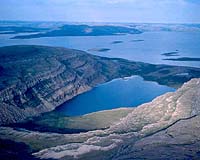
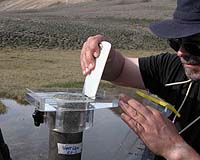
Kingston ON (SPX) Mar 01, 2005 Unprecedented and maybe irreversible effects of Arctic warming, linked to human intervention, have been discovered by a team of international researchers led by Queen's University biologist John Smol and University of Alberta earth scientist Alexander Wolfe. The researchers have found dramatic new evidence of changes in the community composition of freshwater algae, water fleas and insect larvae (the base of most aquatic food webs) in a large new study that covers five circumpolar countries extending halfway around the world and 30 degrees of latitude spanning boreal forest to high arctic tundra ecosystems. "This is an important compilation of data that human interference is affecting ecosystems on a profound scale," says Dr. Smol, Canada Research Chair in Environmental Change and 2004 winner of Canada's top science award, the Gerhard Herzberg Gold Medal. "We're crossing ecological thresholds here, as shown by changes in biota associated with climate-related phenomena like receding ice cover in lakes. Once you pass these thresholds it's hard to go back." The team's findings, in the largest study of its kind, will be published the week of February 28 in the Proceedings of the National Academy of Sciences (PNAS). A total of 26 researchers from Canada, Finland, Norway, the UK, and Russia have produced 55 historical profiles of algal and invertebrate animal remains from the sediment in 46 Arctic lakes. Also on the team from Queen's are biologist Kathleen R�hland and PhD student Bronwyn Keatley. John Birks, a professor at the University of Bergen and adjunct professor at Queen's, quantified the amount of biological change using statistical approaches. The new study shows that climate change has lengthened summers and reduced lake ice cover across much of the Arctic. This in turn prolongs the growing season available to highly sensitive lake organisms, and opens up new habitats. The most intense population changes occurred in the northernmost study sites, where the greatest amount of warming appears to have taken place, the researchers say.

|