|
 |
 |
 |
 |
 |
 |
 |
 |

 |
Why A Whale Shark's Spots Could Help Save Its Skin
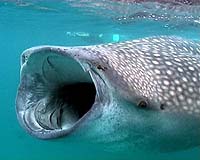
Greenbelt MD (SPX) Oct 07, 2005 Computer software developed by astrophysicists to locate stars and galaxies in the night sky could help save the whale shark - whose spotted skin is like a starry sky - from extinction, according to new research published in the British Ecological Society's Journal of Applied Ecology. Together with Australian marine biologist Brad Norman and JAVA programmer and software specialist Jason Holmberg, astrophysicist Dr Zaven Arzoumanian of the Universities Space Research Association and NASA's Goddard Space Flight Center in Maryland discovered that a pattern-matching algorithm developed by astronomers to locate celestial objects could be used to identify individual whale sharks. Whale sharks' spots are analogous to bright stars in the night sky, allowing the trio of researchers to adapt the star pattern recognition technique to the characteristic markings found on the largest fish in the sea. "This is an example of space technology finding an important application here on Earth," says Arzoumanian. According to Arzoumanian: "The contrast of white whale shark spots on darker skin is well suited to a machine vision technique known as 'blob extraction', which measures the locations and dimensions of pixel groups of a single colour. The spatial relationships between these groups, represented by a set of x, y coordinates, form the basis for a unique identifier for each shark." In the same way that individual whales can be identified by the shape and markings on their flukes, photographic identification of individual whale sharks through their spot pattern "fingerprints", as well as other markers, has long been possible. However, the full potential of photographic identification has rarely been exploited because of the unmanageable task of making visual identification in large data sets, so using pattern-matching to automate the process is a major advance. Once photographed, the technique means a whale shark has been "virtually tagged". According to Norman: "Identifying individuals repeatedly through photography can also inform biological observations such as age of maturity, growth rate and foraging ecology." The authors, devoting their own time and resources, have set up the ECOCEAN Whale Shark Photo-identification Library to act as a single repository for whale shark photographs taken by divers and tourists as well as researchers. "The implications of this computer-aided identification technique and web-based photo library for management and conservation of whale sharks may be profound," Norman says. Without knowing more about the population size, structure and evolution of migratory species like the whale shark, it is impossible to know whether conservation efforts should be directed locally or internationally, or whether marine reserves are effectively protecting them. Whale sharks are listed as "vulnerable to extinction" by the World Conservation Union (IUCN). Up to 20 metres long, the whale shark is the world's largest fish and lives mainly in the warm water belt north and south of the equator. Whale sharks pose no danger to humans as they are filter-feeders. Community Email This Article Comment On This Article Related Links SpaceDaily Search SpaceDaily Subscribe To SpaceDaily Express Darwin Today At TerraDaily.com
 Panda Paparrazi Swoons Over Cub Tai Shan At Washington Zoo
 Washington (AFP) Nov 29, 2005
There was 'panda-monium' at Washington's National Zoo on Tuesday as fluffy giant panda cub Tai Shan cavorted for the cameras, in his first encounter with the media pack. |
|
|

| The content herein, unless otherwise known to be public domain, are Copyright 1995-2006 - SpaceDaily.AFP and UPI Wire Stories are copyright Agence France-Presse and United Press International. ESA PortalReports are copyright European Space Agency. All NASA sourced material is public domain. Additionalcopyrights may apply in whole or part to other bona fide parties. Advertising does not imply endorsement,agreement or approval of any opinions, statements or information provided by SpaceDaily on any Web page published or hosted by SpaceDaily. Privacy Statement |