
 |
 |
 |
 |
 |
 |
 |
 |
 |

 |
When Mars Was A Water World
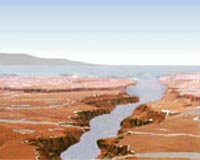
Moffett Field CA (SPX) Jul 21, 2008 Mars once hosted vast lakes, flowing rivers and a variety of other wet environments that had the potential to support life, according to two new studies based on data from the Compact Reconnaissance Imaging Spectrometer for Mars (CRISM) and other instruments on board NASA's Mars Reconnaissance Orbiter (MRO). "The big surprise from these new results is how pervasive and long-lasting Mars' water was, and how diverse the wet environments were," says Scott Murchie, CRISM's principal investigator at the Johns Hopkins University Applied Physics Laboratory (APL), in Laurel, Md. One study, published in the July 17 issue of Nature, shows that vast regions of the ancient highlands of Mars -- which cover about half the planet -- contain clay minerals, which can form only in the presence of water. Volcanic lavas buried the clay-rich regions during subsequent, drier periods of the planet's history, but impact craters later exposed them at thousands of locations across the planet. The clay-like minerals, called phyllosilicates, preserve a record of the interaction of water with rocks dating back to what is called the Noachian period of Mars' history, about 4.6 to 3.8 billion years ago. This period corresponds to the earliest years of the solar system, when Earth, the moon and Mars sustained a cosmic bombardment by comets and asteroids. Rocks of this age have largely been destroyed on Earth by plate tectonics; they are preserved on the moon, but were never exposed to liquid water. The phyllosilicate-containing rocks on Mars therefore preserve a unique record of liquid water environments - possibly suitable for life - in the early solar system. "The minerals present in Mars' ancient crust show a variety of wet environments," says John Mustard, a member of the CRISM team from Brown University in Providence, R.I., and lead author of the Nature study. "In most locations the rocks are lightly altered by liquid water, but in a few locations they have been so altered that a great deal of water must have flushed though the rocks and soil. This is really exciting because we're finding dozens of sites where future missions can land to understand if Mars was ever habitable and if so, to look for signs of past life." A companion study, published in the June 2 issue of Nature Geosciences, finds that the wet conditions persisted for a long time. Thousands to millions of years after the clays were formed, a system of river channels eroded them out of the highlands and concentrated them in a delta where the river emptied into a crater lake slightly larger than California's Lake Tahoe, about 25 miles (40 kilometers) in diameter. "The distribution of clays inside the ancient lakebed shows that standing water must have persisted for thousands of years," says Bethany Ehlmann, another member of the CRISM team from Brown and lead author of the study of the ancient lake within Jezero Crater. "Clays are wonderful at trapping and preserving organic matter, so if life ever existed in this region, there's a chance of its chemistry being preserved in the delta." CRISM's combination of high spatial and spectral resolutions-better than any previous imaging spectrometer sent to Mars-reveals variations in the types and composition of the phyllosilicate minerals. By combining data from CRISM and MRO's Context Imager (CTX) and High Resolution Imaging Science Experiment (HiRISE), the team has identified three principal classes of water-related minerals dating to the early Noachian period: aluminum-phyllosilicates, hydrated silica or opal, and the more common and widespread iron/magnesium-phyllosilicates. The variations in the minerals suggest that different processes, or different types of watery environments, created them. "Our whole team is turning our findings into a list of sites where future missions could land to look for organic chemistry and perhaps determine whether life ever existed on Mars," says APL's Murchie. APL, which has built more than 150 spacecraft instruments over the past four decades, led the effort to build CRISM, and operates the instrument in coordination with an international team of researchers from universities, government and the private sector. The Jet Propulsion Laboratory of the California Institute of Technology, Pasadena, manages the Mars Reconnaissance Orbiter mission for NASA's Science Mission Directorate. Lockheed Martin Space Systems, Denver, is the prime contractor for the project and built the spacecraft. Community Email This Article Comment On This Article Share This Article With Planet Earth
Related Links Mars News and Information at MarsDaily.com Lunar Dreams and more
 NASA Spacecraft Shows Diverse, Wet Environments On Ancient Mars
 Washington DC (SPX) Jul 21, 2008
Two studies based on data from NASA's Mars Reconnaissance Orbiter have revealed that the Red Planet once hosted vast lakes, flowing rivers and a variety of other wet environments that had the potential to support life. |
|
|

| The content herein, unless otherwise known to be public domain, are Copyright 1995-2007 - SpaceDaily.AFP and UPI Wire Stories are copyright Agence France-Presse and United Press International. ESA Portal Reports are copyright European Space Agency. All NASA sourced material is public domain. Additional copyrights may apply in whole or part to other bona fide parties. Advertising does not imply endorsement,agreement or approval of any opinions, statements or information provided by SpaceDaily on any Web page published or hosted by SpaceDaily. Privacy Statement |
 del.icio.us
 Digg
Digg Reddit
 YahooMyWeb
 Google
 Facebook