|
 |
 |
 |
 |
 |
 |
 |
 |

 |
Voyager Data May Reveal Trajectory Of Solar System
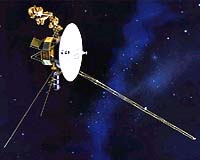
Newport Beach CA (SPX) Jun 01, 2006 Nearly 30 years after launch, the two Voyager spacecraft are still operational and returning useful data. In their early years they produced some of the first close up images of the large outer planets. Now as the two vehicles, flying in slightly different directions, near the edge of the solar system, they are providing clues on the shape of heliosphere, and quite possibly, the direction of the solar system through local space. The heliosphere, generated by the Sun, is sort of the cocoon in which the solar system rides. It has been suspected for several years that it is not spherical but more egg shaped. Voyager 1 recently reached one edge and it is estimated it will pass into interstellar space at about 12.4 billion miles from the Sun. It was recently announced that Voyager 2 has reached its more southerly edge, sooner than expected. It is now believed it will reach interstellar space at about 10.5 billion miles. This reveals that the heliosphere is not a sphere after all, but is more of a comet shape. According to Cal Tech's Ed Stone, the former director of NASA's Jet Propulsion Laboratory and a Voyager chief scientist, the shape of the bubble is determined by what is pressing on the solar system from the outside, meaning the shape and force of interstellar gases. That is one explanation. Another put forth by Walter Cruttenden of the Binary Research Institute is that local gases are fairly uniform and the shape derives from the trajectory of the solar system through local space � possibly in its orbit around a companion star. While this latter explanation is far more speculative, it is not unlikely that local interstellar gases are relatively homogeneous and therefore the shape of the heliosphere may be at least partially due to motion of the solar system. Voyager 1 and 2 are expected to remain active for several more decades. In that time we should gain a better understanding of the motion of the solar system and its surrounding neighborhood. Community Email This Article Comment On This Article Related Links Voyager Space Tourism, Space Transport and Space Exploration News
 A Voyage To The Edge Of Sol
 Pasadena CA (SPX) May 31, 2006
As the 28-year-old Voyagers 1 and 2 spacecraft approach the edge of interstellar space, they have found that the heliosphere, the "bubble" within which the sun dominates, bulges outward in the northern hemisphere and is pressed inward in the south. |
|
|

| The content herein, unless otherwise known to be public domain, are Copyright 1995-2006 - SpaceDaily.AFP and UPI Wire Stories are copyright Agence France-Presse and United Press International. ESA PortalReports are copyright European Space Agency. All NASA sourced material is public domain. Additionalcopyrights may apply in whole or part to other bona fide parties. Advertising does not imply endorsement,agreement or approval of any opinions, statements or information provided by SpaceDaily on any Web page published or hosted by SpaceDaily. Privacy Statement |