|
 |
 |
 |
 |
 |
 |
 |
 |

 |
Visualizing Viruses
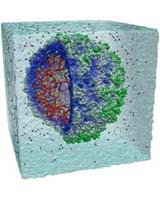
Chicago IL (SPX) Mar 21, 2006 When Boeing and Airbus developed their latest aircraft, the companies' engineers designed and tested them on a computer long before the planes were built. Biologists are catching on. They've just completed the first computer simulation of an entire life form -- a virus. In their quest to study life, biologists apply engineering knowledge somewhat differently: They "reverse engineer" life forms, test fly them in the computer, and see if they work in silico the way they do in vivo. This technique previously had been employed for small pieces of living cells, such as proteins, but not for an entire life form until now. The accomplishment, performed by computational biologists at the University of Illinois at Urbana-Champaign and crystallographers at the University of California at Irvine, is detailed in the March issue of the journal Structure. Deeper understanding of the mechanistic properties of viruses, the researchers say, could not only contribute to improvements in public health, but also in the creation of artificial nanomachines made of capsids -- a small protein shell that contains a viral building plan, a genome, in the form of DNA or RNA. Viruses are incredibly tiny and extremely primitive life forms that cause myriad diseases. Biologists often refer to them as particles rather than organisms. Viruses hijack a biological cell and make it produce many new viruses from a single original. They've evolved elaborate mechanisms of cell infection, proliferation and departure from the host when it bursts from viral overcrowding. For their first attempt to reverse engineer a life form in a computer program, computational biologists selected the satellite tobacco mosaic virus because of its simplicity and small size. The satellite virus they chose is a spherical RNA sub-viral agent that is so small and simple that it can only proliferate in a cell already hijacked by a helper virus -- in this case the tobacco mosaic virus that is a serious threat to tomato plants. A computer program was used to reverse engineer the dynamics of all atoms making up the virus and a small drop of salt water surrounding it. The virus and water contain more than a million atoms altogether. The necessary calculation was done at Illinois on one of the world's largest and fastest computers operated by the National Center for Supercomputing Applications. The computer simulations provided an unprecedented view into the dynamics of the virus. "The simulations followed the life of the satellite tobacco mosaic virus, but only for a very brief time," said co-author Peter Freddolino, a doctoral student in biophysics and computational biology at Illinois. "Nevertheless, they elucidated the key physical properties of the viral particle as well as providing crucial information on its assembly." It may take still a long time to simulate a dog wagging its tail in the computer, said co-author Klaus Schulten, Swanlund Professor of Physics at Illinois. "But a big first step has been taken to 'test fly' living organisms," he said. "Naturally, this step will assist modern medicine as we continue to learn more about how viruses live." The computer simulations were carried out in Schulten's Theoretical and Biophysics Group's lab at the Beckman Institute for Avanced Science and Technology. Community Email This Article Comment On This Article Related Links University of Illinois at Urbana-Champaign University of California at Irvine Darwin Today At TerraDaily.com
 Behavioral Studies Show UV Contributes To Marsupial Color Vision
 Perth, Australia (SPX) Mar 21, 2006
Work reported this week provides new evidence that marsupials, like primates, have functional color vision based on three different types of color photoreceptor cones--but unlike primates, a component of marsupial color vision includes sensitivity to ultraviolet wavelengths. |
|
|

| The content herein, unless otherwise known to be public domain, are Copyright 1995-2006 - SpaceDaily.AFP and UPI Wire Stories are copyright Agence France-Presse and United Press International. ESA PortalReports are copyright European Space Agency. All NASA sourced material is public domain. Additionalcopyrights may apply in whole or part to other bona fide parties. Advertising does not imply endorsement,agreement or approval of any opinions, statements or information provided by SpaceDaily on any Web page published or hosted by SpaceDaily. Privacy Statement |