|
 |
 |
 |
 |
 |
 |
 |
 |

 |
Visible Universe Trapped In A Dark Matter Web
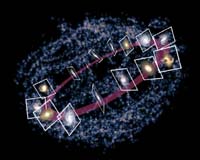
Leicester England (SPX) Apr 05, 2006 Astronomers have found the first direct evidence that galaxies are tightly aligned along a pattern dictated by the large-scale structure of the invisible dark matter that surrounds them. The discovery confirms one of the fundamental aspects of galaxy-formation theory, and implies a direct link between the global properties of the universe and the individual properties of galaxies. A team from the University of Nottingham, England, and the Instituto de Astrofisica de Canarias, Spain, analyzed huge voids found in the universe's large-scale structure. They detected the voids by using the latest sky surveys to search for large regions of space depleted of bright galaxies. The surveys - the Sloan Digital Sky Survey and the Two Degree Field Survey - contain positional information on more than half a million galaxies located within a distance of 1 billion light-years of Earth. "We found that there is an excess of disk galaxies that are highly inclined relative to the plane defined by the large-scale structure surrounding them," said Ignacio Trujillo of the University of Nottingham. "Their rotation axes are mainly oriented in the direction of the filaments (and) our work provides important confirmation of the tidal torque theory which explains how galaxies have acquired their current spin." He said the spin of the galaxies is thought to be linked to their morphological shapes. "So, this work is a step forward on our understanding of how galaxies have reached their current shapes," he added. It turns out matter is not distributed uniformly throughout space, but instead is arranged in an intricate cosmic web of filaments and walls surrounding bubble-like voids, alternating between galaxy clusters and low-density regions known as voids. Astronomers call this uneven scattering of matter the large-scale distribution of the universe. When viewing the entire universe in computer simulations, the distribution assumes the appearance of a spider's web or the neural network of the brain - although this structure did not always exist. After the Big Bang, matter was distributed more homogeneously. As the universe evolved, however, gravitational pulls began to compress matter in certain regions of space, eventually forming the current large-scale structure. Recent models have predicted that galaxies tended to cluster perpendicularly to the direction of the linear filaments. Several observational studies have looked for a preferential alignment of galaxy rotation with respect to the surrounding large-scale structures, but none was successful, until now, because of the difficulty in characterizing the filaments. The research, by Trujillo with Conrado Carretero and Santiago G. Patiri of the Instituto de Astrofisica, has been able to measure this effect, confirming theoretical predictions. The team's paper appears in the April 1 issue of Astrophysical Journal Letters. Community Email This Article Comment On This Article Related Links Research Abstract Galactic Web Images SDSS TDFS Stellar Chemistry, The Universe And All Within It
 Hubble Spies Nearby Dust Clouds In Milky Way
 Baltimore MD (SPX) Apr 05, 2006
New images by the Hubble Space Telescope have captured dense blobs of dust and gas in a relatively nearby star-forming region of the Milky Way. The cosmic dust bunnies contain elements responsible for the formation of stars in the galaxy and elsewhere throughout the universe. |
|
|

| The content herein, unless otherwise known to be public domain, are Copyright 1995-2006 - SpaceDaily.AFP and UPI Wire Stories are copyright Agence France-Presse and United Press International. ESA PortalReports are copyright European Space Agency. All NASA sourced material is public domain. Additionalcopyrights may apply in whole or part to other bona fide parties. Advertising does not imply endorsement,agreement or approval of any opinions, statements or information provided by SpaceDaily on any Web page published or hosted by SpaceDaily. Privacy Statement |