|
 |
 |
 |
 |
 |
 |
 |
 |

 |
Violet Will Enable Chips Of Ultra Level
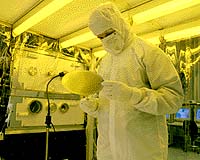
Livermore - April 12, 2001 Industry and government officials today announced completion of the first full-scale prototype machine for making computer chips using extreme ultraviolet (EUV) light, a breakthrough that will lead to microprocessors that are tens of times faster than today�s most powerful chips and create memory chips with similar increases in storage capacity. Akin to photography, lithography is used to print circuits onto microchips. EUV lithography was developed because the current chip-printing technology is expected to reach its physical limits in the next few years. Current lithography technology is expected to allow manufacturers to eventually print circuits as small as 0.1 micron in width, or 1/1,000th the width of a human hair. EUV lithography technology is being developed to allow semiconductor manufacturers to print circuit lines well below 0.1 micron � down to at least 0.03 microns, extending the current pace of semiconductor innovation at least through the end of this decade. "The completion of the prototype machine marks a major milestone for the program, since we have proven that EUV lithography works," said Chuck Gwyn, program manager of the EUV Limited Liability Company (LLC). "Our next step is to transfer the technology to lithography equipment manufacturers to develop beta and production tools." Processors built using EUV technology are expected to reach speeds of up to 10 GHz in 2005-2006. By comparison, the fastest Pentium 4 processor today is 1.5 GHz. The prototype machine, called the Engineering Test Stand (ETS), was developed by industry-government collaboration among three U.S. Department of Energy national laboratories and a consortium of semiconductor companies called the EUV LLC. The consortium includes Intel Corporation, Motorola Inc., Advanced Micro Devices Inc., Micron Technology Inc., Infineon Technologies, and International Business Machines. The three DOE national laboratories, combining EUV research efforts in a Virtual National Laboratory, are Lawrence Berkeley National Laboratory, Lawrence Livermore National Laboratory, and Sandia National Laboratories in California. Using the EUV LLC, private industry has funded 100 percent of the EUV lithography research through an agreement that spans from 1997 through early 2002. "The EUVL partnership demonstrates that fundamental science and innovative ideas can be applied toward solutions in both the commercial and public sectors," said John Gordon, administrator of the DOE�s National Nuclear Security Administration. "These kinds of challenges are exactly the kind of work our national laboratories do best." The ETS was assembled at Sandia in Livermore, California. It will be used by LLC partners and lithography tool suppliers during the next year to refine the technology and get it ready to create a prototype commercial machine that meets industry requirements for high-volume chip production. The EUV LLC has developed relationships with more than 40 U.S.-based infrastructure companies to ensure that all of the key components can be attained for commercialization. Community Email This Article Comment On This Article Related Links Background On Extreme Ultra Violet Lithography (EUVL) SpaceDaily Search SpaceDaily Subscribe To SpaceDaily Express Space
 Satellite Launch To Boost DTH In India
 Calcutta, India (SPX) Dec 28, 2005
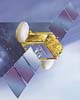
The successful launch Thursday of India's heaviest satellite from spaceport of Kourou in French Guyana may have boosted the country's space research efforts to yet another level, but it has also lifted the spirits of at least three Direct-To-Home televisions broadcasters, one of which has been waiting for years to launch its services in India. |
|
|

|
|
|
|
|
|
|
|
|
|
|
|
| The content herein, unless otherwise known to be public domain, are Copyright 1995-2006 - SpaceDaily.AFP and UPI Wire Stories are copyright Agence France-Presse and United Press International. ESA PortalReports are copyright European Space Agency. All NASA sourced material is public domain. Additionalcopyrights may apply in whole or part to other bona fide parties. Advertising does not imply endorsement,agreement or approval of any opinions, statements or information provided by SpaceDaily on any Web page published or hosted by SpaceDaily. Privacy Statement |