
 |
 |
 |
 |
 |
 |
 |
 |
 |

 |
Violent Radiation Blast Spawned Planets
Dublin - September 9, 1999 - 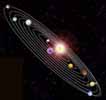 Dublin - September 9, 1999 - The formation of the Solar System was hurried along by a nearby gamma- ray burst, two astrophysicists in Ireland suspect. Rather than aborting the birth of planets, the flood of energy may have melted primordial dust grains, seeded the formation of meteorites and helped form the rocky planets, including Earth.
For over a century, astronomers have tried to understand what made clumps of dust circling the young Sun melt into chondrules-rocky beads rich in iron and silicon minerals that make up the bulk of stony meteorites. Suggestions included shock waves and gigantic flashes of lightning. Now Brian McBreen and Lorraine Hanlon of University College Dublin suggest that all the chondrules in the Solar System formed in a matter of minutes 4.5 billion years ago when a gamma-ray burst-one of the most powerful explosions in the universe-seared the dust and gas circling the Sun with intense X-rays and gamma rays. Astronomers aren't sure what causes gamma-ray bursts, but they may occur when supermassive stars explode at the end of their lives (New Scientist, 3 April, p 5). In a paper that will appear in a future issue of Astronomy and Astrophysics, McBreen and Hanlon calculate that a gamma-ray burst within 300 light years would have flooded the dusty disc circling the young Sun with enough energy to fuse up to 100 Earth masses of material into droplets that cooled into chondrules. These, and the dust from which they formed, are rich in iron, which would have soaked up X-rays and gamma rays very efficiently. "It explains the key role played by iron, which dominates the X-ray and gamma-ray absorption," says McBreen. If the theory is right, it makes the Solar System more unique than many scientists would like. McBreen and Hanlon believe that only one Sun-like star in a thousand would have been close enough to a gamma-ray burst to form chondrules. Because they also think that the dense chondrules settle quickly into the plane of a protoplanetary disc and speed the formation of planets, their theory implies that solar systems such as ours are rare. "Forming chondrules really is a long-standing problem, so if this mechanism accounts for them, that would be pretty fantastic," says Alan Boss, an astrophysicist at the Carnegie Institution in Washington DC. Still, he is reluctant to rely on an unlikely event as a crucial factor in the formation of the Solar System, and wonders whether the idea can explain other features of chondrules, such as their size and abundance. "I don't think you'd want to invoke it unless it takes care of everything," he says. Specialists in meteorites are intrigued by McBreen's idea. "Chondrule formation remains a thorny subject, so it's good to see a new idea in the area," says Ian Wright, a meteoriticist at the Open University in London. He notes that most of the researchers studying meteorites believe chondrules did not form all at once, although the case is not closed. "It will certainly cause debate, and it's an interesting idea that can be tested in our labs."
Additional Offsite Links
Email This Article Comment On This Article Related Links Space
 Satellite Launch To Boost DTH In India
 Calcutta, India (SPX) Dec 28, 2005
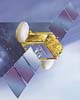
The successful launch Thursday of India's heaviest satellite from spaceport of Kourou in French Guyana may have boosted the country's space research efforts to yet another level, but it has also lifted the spirits of at least three Direct-To-Home televisions broadcasters, one of which has been waiting for years to launch its services in India. |
|
|

|
|
|
|
|
|
|
|
|
|
|
|
| The content herein, unless otherwise known to be public domain, are Copyright 1995-2006 - SpaceDaily.AFP and UPI Wire Stories are copyright Agence France-Presse and United Press International. ESA PortalReports are copyright European Space Agency. All NASA sourced material is public domain. Additionalcopyrights may apply in whole or part to other bona fide parties. Advertising does not imply endorsement,agreement or approval of any opinions, statements or information provided by SpaceDaily on any Web page published or hosted by SpaceDaily. Privacy Statement |

