|
 |
 |
 |
 |
 |
 |
 |
 |

 |
Utah Professor Developes Technology That Could Change The Aerospace Industry
Logan UT (SPX) Jun 21, 2004 Utah State University has applied for a patent for an invention that may save the airline industry and private, military and transport airplanes hundreds of millions in fuel costs each year. Warren F. Phillips, a professor for 30 years in the mechanical and aerospace engineering department at Utah State and a hang glider pilot, invented a technology called Twisteron to minimize drag on airplanes as they fly. "If we can reduce drag on an airplane by even as little as 1 percent, it would create a tremendous amount of savings in fuel for the airline industry and the US economy," Phillips said. Phillips, who recently published a textbook called "Mechanics of Flight," explained drag as the force that one feels when putting an arm out the window of a moving car. The force pushing the arm back is drag. When twisting the arm, one will feel an upward force, which is called lift. Drag and lift are the aerodynamic forces that act on an airplane in flight. "Drag is what you pay for; it is a hindrance," Phillips said. "In my hang glider the drag is what causes me to eventually sink back to Earth. When an airplane like a 747 is flying at 40 thousand feet, the engines are running only to overcome the force of drag." A typical 747 will burn about 75 gallons of fuel a minute and can weigh up to 750 thousand pounds. Half of its weight can be fuel. According to the Federal Aviation Administration, in 2004 US civil aviation aircraft are expected to consume more than 24 billion gallons of jet fuel. "You can look up anytime, almost anywhere on Earth and see a plane in the sky," Philips said. "Airplanes burn a tremendous amount of fuel." Twisterons work by twisting the wings during flight. Twisting wings is a concept that has been around since the Wright brothers made their first flight and used wing warping. The wings of the Wright Flyer were twisted in opposite directions in order to turn. Utah State�s Twisteron technology is a little different. The wings are twisted in the same direction using a precise formula to help reduce drag. "The amount of twist the Twisterons use is determined by altitude, weight and the speed the airplane is traveling," Phillips said. "Those conditions change during flight. The Twisterons adjust to those changes to always produce minimum drag." This technology was tested during the 2003 National Design, Build, Fly competition. Utah State students designed and built an airplane with Twisterons. Their design report won first place. The airplane experienced a 20 percent reduction in drag during steep turns and a 7 percent reduction in level flight. "High lift or low speed situations, such as takeoff, landing and steep turns are when you get the greatest fuel savings," Phillips said. "You wouldn�t experience a significant G-force when turning in a commercial airliner, but even a small savings would make a huge impact." Phillips said the idea came to him overnight. He woke up one morning knowing all about Twisterons and did not know anything about them when he went to bed the night before. He said his experience as a hang glider pilot may have also played a role. "Hang gliding gives you a real feel for flight," the Utah State professor said. "I have flown airplanes, and when you are flying an airplane you are driving a machine. When you are flying a hang glider it is literally like being a bird; you feel the air and your thoughts control the glider. It gives a real feel for lift, drag, and how the air interacts with the wings, much more so than you would get from flying a machine." Phillips said he has won an award for a paper he published on Twisteron technology, and his peers are impressed with the technology because of its simplicity and the beauty of the mathematics that led to it. He hopes the technology will be put to use and his invention will change the airline industry for the better. Utah State University Research Foundation�s Technology Commercialization Office (TCO) is looking to license the technology to commercial aircraft manufacturers and possibly others. The technology may also have use beyond aviation. The technique may be applied to water craft or land vehicles. "With jet fuel costing over $15 billion in the US in 2003 this technology will have significant economic impact, especially in a time when we are seeing a continual increase in fuel prices." Ray DeVito, Ph.D., physical science commercialization manager at TCO, said. Using the 2003 figures DeVito calculated that if a reduction in drag of 2.5 percent was achieved in commercial airplanes it would amount to about $400 million of savings in fuel costs. "As jet fuel consumption increases and prices rise, the potential savings would approach a billion dollars per year over the next decade," DeVito said. Utah State University�s mechanical and aerospace engineering students have notable experience in designing and building planes. Their accomplishments include the building of the internationally renowned USU Wright Flyer, the only stable flying replica of the Wright Flyer. They won first place for their design report in the National Design Build Fly Contest four times and won the total competition twice, giving Utah State University the distinction of being the only university to have won it more than once. Community Email This Article Comment On This Article Related Links Utah State University SpaceDaily Search SpaceDaily Subscribe To SpaceDaily Express Space Tourism, Space Transport and Space Exploration News
 NASA Refines Design For Crew Exploration Vehicle
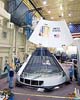 Washington DC (SPX) Jan 12, 2006
NASA's Constellation Program is making progress toward selecting a prime contractor to design, develop and build the Crew Exploration Vehicle (CEV), America's first new human spacecraft in 30 years. |
|
|

| The content herein, unless otherwise known to be public domain, are Copyright 1995-2006 - SpaceDaily.AFP and UPI Wire Stories are copyright Agence France-Presse and United Press International. ESA PortalReports are copyright European Space Agency. All NASA sourced material is public domain. Additionalcopyrights may apply in whole or part to other bona fide parties. Advertising does not imply endorsement,agreement or approval of any opinions, statements or information provided by SpaceDaily on any Web page published or hosted by SpaceDaily. Privacy Statement |