|
 |
 |
 |
 |
 |
 |
 |
 |

 |
Us Academy Wants Ban On Human Cloning But Hails Therapeutic Procedure
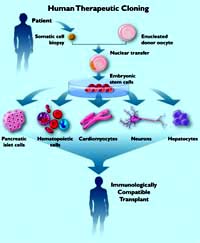
Washington (AFP) Jan 19, 2002 A blue-ribbon panel sponsored by the US National Academy of Sciences called Friday for a strict ban on human cloning but -- in stark disagreement with the Bush administration -- backed creation of new stem cell lines for medical research. "Unlike reproductive cloning, the creation of embryonic stem cells by nuclear transplantation does not involve implantation of a preimplantation embryo, called a blastocyst, in a uterus," said Bruce Alberts, president of the National Academy of Sciences, as he presented the panel's report. He argued that studies of stem cells isolated through nuclear transplantation "should increase the understanding and potential treatment of various diseases and debilitating disorders, as well as fundamental biomedical knowledge." The finding places the academy at odds with a policy announced by US President George W. Bush last August, when he declared that the US government would fund embryonic stem cell research only on existing stem cell lines. The White House also took a hard line against Massachusetts-based company Advanced Cell Technology, which announced in November that it had effectively cloned early-stage embryos by performing somatic nuclear cell transfers. Bush decried this research procedure as "morally wrong." "We should not, as a society, grow life to destroy it, and that's exactly what's taking place," he said. Without engaging in direct polemics with the White House, the panel of 13 top US experts in the field disagreed, saying research of stem cell-derived tissues "should be actively pursued." It said research on cells created through nuclear transplantation can offer new clues to understanding and fighting Alzheimer's disease and genetic disorders. "Finally, studies of genetic reprogramming and genetic imprinting will be substantially enhanced through the use of stem cells derived by nuclear transplantation, compared with studies with stem cells derived from other sources," the scientists said. Unlike reproductive cloning, creation of embryonic stem cells by nuclear transplantation does not involve implantation of a blastocyst in a uterus and, therefore cannot produce a human being. By contrast, the goal of reproductive cloning is creation of a newborn genetically identical to another human being. The procedure calls for placing the blastocyst in a uterus, which can result in the formation of a fetus. On this issue, the panel agreed with Bush by saying the US government should impose "a legally enforceable ban on the practice of human reproductive cloning" because "it is dangerous and likely to fail." "Data on the reproductive cloning of animals demonstrate that only a small percentage of attempts are successful, many of the clones die during all stages of gestation, newborn clones often are abnormal or die, and the procedures may carry serious risks for the mother," said Irving Weissman, a professor of pathology at Stanford University in California, who chaired the panel. He said the scientists had agreed that the proposed ban on human cloning should be reviewed within five years, but it should be reconsidered only if a new scientific review indicated that the procedures are likely to be safe and effective and a national debate on social, religious and ethical issues suggests that reconsideration was warranted. The US House of Representatives passed a bill last year banning human cloning. The Senate has yet to consider the measure.
Hold The Pig Heart Many doctors are excited by the idea of so-called xenotransplants due to a worldwide shortage of human transplant organs. But many governmental health bodies are cautious amid evidence that killer viruses, from HIV to Lassa fever and Ebola, are able to leap the species barrier to humans. The Canadian group's recommendations to Health Minister Allan Rock follow last week's announcement by two scientific teams -- one in Britain and another in the United States -- that they had cloned a batch of pigs which lack a gene that cause pig organs to be rejected by the human body. The non-profit Canadian Public Health Association, commissioned by Health Canada last year, conducted citizen forums in six Canadian cities and also carried out mail, phone and Internet interviews. The advisory group found that initially Canadians supported proceeding with xenotransplantation in human trials, but when better informed of its risks changed their minds. For example, of the 107 people interviewed in the forums, initially 55 percent had been in favor of xenotransplantation, 27 against and 18 percent undecided. At the end of the two-day forums, 46 percent supported proceeding with the transplants, 53 percent were against and one undecided. "Canadians recognize the critical shortage (of organs) ... however, at this time, they still felt that the risks outweighed the benefits," Doctor Heather Ross, a co-chair of the group, told AFP. Ross, the director of the cardiac transplant program at the University Health Network -- a grouping of three Toronto hospitals -- said that 3,000 to 4,000 Canadians at any given time are awaiting for some type of transplants. The public also called on Ottawa to explore alternative means to respond to the organ shortage, such as prevention, expanding the human donor pool and mechanical substitutes and stem cell research, she said. "Minister Rock said that he would use this information to help guide future decision-making about xenotransplanting in Canada," Ross added. Presently, there are no regulations or legislation in place about animal-to-human transplants. CommunityEmail This Article Comment On This Article Related Links SpaceDaily Search SpaceDaily Subscribe To SpaceDaily Express The Clone Age - Cloning, Stem Cells, Space Medicine
 Living Forever
 Washington (UPI) Jan 04, 2006
Praised as the Thomas Edison of the 21st century, Ray Kurzweil was selected as one of "16 revolutionaries who made America," along with the great inventors of the past two centuries. |
|
|

| The content herein, unless otherwise known to be public domain, are Copyright 1995-2006 - SpaceDaily.AFP and UPI Wire Stories are copyright Agence France-Presse and United Press International. ESA PortalReports are copyright European Space Agency. All NASA sourced material is public domain. Additionalcopyrights may apply in whole or part to other bona fide parties. Advertising does not imply endorsement,agreement or approval of any opinions, statements or information provided by SpaceDaily on any Web page published or hosted by SpaceDaily. Privacy Statement |