|
 |
 |
 |
 |
 |
 |
 |
 |

 |
Urban Interests Harmed By Wetland Development Program
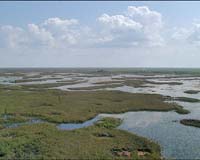
Tallahassee FL (SPX) Mar 30, 2006 A federal policy that allows developers to compensate for damaging or destroying wetlands by buying wetlands elsewhere has environmental consequences that can be especially harmful to urban areas, according to a Florida State University law professor in Tallahassee, Fla. J.B. Ruhl, the Matthew and Hawkins Professor of Property at the FSU College of Law, said that the policy of "wetland mitigation banking" redistributes wetland resources from urban areas to rural ones, potentially leaving city dwellers with fewer important environmental services such as water filtration, erosion protection and flood control. "Completely different populations are winners and losers in terms of locally delivered wetland ecosystem services," Ruhl said. Ruhl and James Salzman, a professor at the Duke University School of Law and the Nicholas School of the Environment, conducted the first comprehensive empirical study of demographic changes prompted by wetland mitigation banking, a rapidly growing industry in the United States. Their findings are outlined in an article, "The Effects of Wetland Mitigation Banking on People," published in the National Wetlands Newsletter. The practice of wetland mitigation banking evolved from state and federal efforts to eliminate a net loss of wetlands nationwide. The Clean Water Act requires land developers who damage or destroy wetlands to create new wetlands either on the development site or somewhere else or pay a third-party entity to do it for them. Wetland mitigation banking is a variation of third-party, off-site mitigation, which allows a developer to purchase "credits" from another landowner - the wetland banker - who has created or enhanced wetland resources elsewhere. For their study, Ruhl and Salzman collected information about all of Florida's active and sold-out wetland banks and the land development projects that purchased credits from them to satisfy the mitigation requirements. They found a clear shift of wetlands from urban to rural areas and significant differences between bank areas and project areas in terms of population density, median income and percentage of minorities. They also found there was considerable distance between banks and their associated projects. "The whole point of wetland mitigation banking - what makes its economic incentives work - is that developers get to wipe out wetland patches in the higher priced land markets and bankers get to establish wetlands banks in the less pricey land markets," Ruhl said. "It's not surprising then that development projects using wetland mitigation banking often are located in urban areas and the banks they use are located in rural areas." Florida has more active banks than most states, but it serves as a good indicator of what may happen, especially in coastal states, as the practice increases, Ruhl said. Mitigation banking has been controversial since its inception about 10 years ago. The U.S. Environmental Protection Agency and the U.S. Army Corps of Engineers have praised wetland mitigation as a better alternative to having developers provide on-site or off-site mitigation themselves. In fact, federal policy now encourages agencies to use mitigation banking to compensate for wetland impacts. While advocates say that banking is far more successful than any other means of compensating for wetland losses, critics say that banks do not adequately replace wetland values and functions. This study is significant because it underscores the need to analyze the value of the ecosystem service losses due to wetlands mitigation banking, according to Ruhl. "We ought to make resource use decisions that are based on a full accounting of costs and benefits," Ruhl said. "This study shows that ecosystem service values, when not integrated into the banking program, get lost in the shuffle. We might be making economically unwise decisions, or at least not fully informed decisions as a result." The researchers concluded that regulatory authorities should monitor bank transactions and make appropriate corrections. For example, authorities could charge a fee for credits purchased from banks that are far away and use the fees to fund public acquisition of urban wetlands or award credit premiums for banks that locate closer to urban areas. Community Email This Article Comment On This Article Related Links Florida State University College of Law Duke University School of Law Bringing Order To A World Of Disasters A world of storm and tempest When the Earth Quakes
 UN Conference Calls For Alert Systems For All Disasters By 2015
 Berlin (AFP) Mar 30, 2006
A UN conference ended here on Wednesday with a call for the whole world to have early warning systems against natural disasters like the Asian tsunami and the Kashmir earthquake by 2015. |
|
|

| The content herein, unless otherwise known to be public domain, are Copyright 1995-2006 - SpaceDaily.AFP and UPI Wire Stories are copyright Agence France-Presse and United Press International. ESA PortalReports are copyright European Space Agency. All NASA sourced material is public domain. Additionalcopyrights may apply in whole or part to other bona fide parties. Advertising does not imply endorsement,agreement or approval of any opinions, statements or information provided by SpaceDaily on any Web page published or hosted by SpaceDaily. Privacy Statement |