|
 |
 |
 |
 |
 |
 |
 |
 |

 |
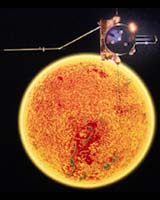
Ulysses Keeps Watch On Steady But Active Star
Paris (ESA) Oct 29, 2003 The mission is progressing nominally, with spacecraft and all scientific instruments in good health. One Anomaly Report was issued during the reporting period, concerning problems with the upload of new software for the GRU/DUST experiment. The problem was traced to the software code itself, and the previous version was subsequently re-loaded successfully pending corrections to the new code. Regarding the possible extension of spacecraft operations beyond September 2004, positive recommendations have been given by the Solar System Working Group at its meeting on 23 April, and by the NASA Sun-Earth Connections (SEC) Senior Review Panel in its final report issued on 5 August. The SSWG in its recommendation noted that the scientific case for a further extension was strong; the Senior Review Panel recommended that Ulysses should be funded through its return to the north solar pole in 2008. On 5 November, Ulysses will be at a radial distance of 5.23 AU from the Sun, and heliographic latitude 5.5� north of the solar equator, on its way to aphelion. All science operations during the reporting period have been nominal. The ESA Ulysses archive Information regarding the data archive may be obtained from the Ulysses Data System Coordinator, Dr. C. Tranquille (Cecil.Tranquilleesa.int).
Science Highlights Theory indicates that changes in the HMF causes a solar cycle variation in the dust distribution. The dust is deflected toward higher latitudes (defocused) when the polar cap field is outward in the north hemisphere and the dust is deflected equator-ward (focused), when the north polarity is inward. The modulation also depends on the inclination of the HCS. Recent measurements by the DUST experiment on board Ulysses have confirmed that the flux does indeed change significantly with the solar cycle. In 1996, near minimum, the interstellar grains began a slow decrease that continued until near maximum (2000) when the flux levelled off and began to increase. The Ulysses DUST team has developed a model that includes changes in the field polarity and the inclination of the solar dipole, and which reproduces the observations and allows an estimate to be made of the relative contribution of grains of different masses. The model predicts a steady increase in the flux of interstellar dust in the inner heliosphere to occur as a result of the recent reversal of the Sun's magnetic polarity. Community Email This Article Comment On This Article Related Links Ulysses at ESA Ulysses at JPL SpaceDaily Search SpaceDaily Subscribe To SpaceDaily Express Solar Science News at SpaceDaily
 From 'Macro' To 'Micro' � Turbulence Seen By Cluster
 Paris (ESA) Aug 11, 2005
Thanks to measurements by ESA's Cluster mission, a team of European scientists have identified 'micro'-vortices in Earth's magnetosphere. |
|
|

| The content herein, unless otherwise known to be public domain, are Copyright 1995-2006 - SpaceDaily.AFP and UPI Wire Stories are copyright Agence France-Presse and United Press International. ESA PortalReports are copyright European Space Agency. All NASA sourced material is public domain. Additionalcopyrights may apply in whole or part to other bona fide parties. Advertising does not imply endorsement,agreement or approval of any opinions, statements or information provided by SpaceDaily on any Web page published or hosted by SpaceDaily. Privacy Statement |