
 |
 |
 |
 |
 |
 |
 |
 |
 |

 |
US space shuttle lands safely after installing Japanese lab
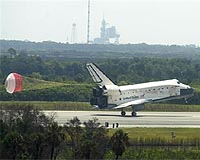
Cape Canaveral, Florida (AFP) June 14, 2008 The US shuttle Discovery touched down in Florida Saturday, capping a successful 14-day mission to deliver and open Japan's first space laboratory at the International Space Station. Under a sunny sky, the orbiter carrying seven astronauts landed right on time at 11:15 am (1515 GMT) at the Kennedy Space Center in Cape Canaveral after gliding over Mexico's Yucatan peninsula as it plunged toward Earth. "Beautiful landing, Mark, and congratulations on a great mission," a mission control official told Discovery commander Mark Kelly. "It's great to be back, and it's great for all of us to be part of a big team that made the station a little bit bigger, a little bit more capable," Kelly replied. After traveling 217 orbits and 9.2 million kilometers (5.7 million miles) around Earth, Discovery plunged toward the planet at more than 20 times the speed of sound before slowing down for its landing. A double sonic boom signaled the shuttle's imminent arrival. Three minutes before landing, Kelly took the shuttle off auto-pilot and steered it toward Kennedy's landing strip number 15. NASA had given the shuttle the green light to wrap up its two-week journey and return to Earth after it determined that the loss of a small clip from its rudder posed no risk during landing. The agency has kept a close eye on the shuttle's protective thermal layer since a crack in Columbia's heat shield caused the orbiter to explode as it re-entered Earth's atmosphere in February 2003, killing its seven astronauts. Discovery undocked from the ISS on Wednesday about 344 kilometers (214 miles) above the South Pacific east of Australia. The shuttle's main task was to deliver, open and outfit the 11.2-meter long, 4.4-meter wide main module of the Japanese Kibo laboratory, which became the station's biggest facility. At a press briefing after the landing, Japanese astronaut Akihiko Hoshide described his feelings when Discovery left the ISS and the Kibo lab he had known and monitored back at the Japan Aerospace Exploration Agency. "When we went to close the hatch, that was a tender moment, it was kind of sad," he said. Kibo -- which means "Hope" in Japanese -- represents Japan's and Asia's first major contribution to the orbiting international station, which already has modules from the United States, Russia and the European Space Agency. Shuttle Endeavour had already brought the bus-sized lab's storage room in March. The third and final part of the lab -- an outdoor facility that will allow experiments to be exposed to the effects of space -- will be delivered next year. When completed, Kibo will allow astronauts to carry out experiments in medicine, biology and biotechnology, material production and communications, both in a pressurized environment and completely exposed to space. "I can't think of a mission really that's been better than this one," said Bill Gerstenmaier, NASA's associate administrator of space operations. "We're starting to break that tie to planet Earth and get out and do what exploration is," he said. The Discovery mission also included three spacewalks. In addition, Discovery brought a new crew member to the ISS, Greg Chamitoff, who replaced fellow American astronaut Garrett Reisman. Reisman returned to Earth after a three-month stint at the outpost, and told NASA TV on Friday that he was primarily looking forward to "being back home, sleeping in my own bed -- and using my own toilet." The only toilet at the International Space Station began to fail just before Discovery's launch, and spare parts were sent up on the shuttle to repair it. NASA hopes to complete construction of the space station by 2010, viewing it as a central part of space exploration ambitions because it allows scientists to study the effects of microgravity on humans. Community Email This Article Comment On This Article Share This Article With Planet Earth
Related Links Shuttle at NASA Watch NASA TV via Space.TV Space Shuttle News at Space-Travel.Com
 Space shuttle cleared to land, loose object poses no risk
 Cape Canaveral, Florida (AFP) June 13, 2008
The US shuttle Discovery was cleared on Friday to return to Earth after a successful mission to deliver and open Japan's first space laboratory at the International Space Station. |
|
|

| The content herein, unless otherwise known to be public domain, are Copyright 1995-2007 - SpaceDaily.AFP and UPI Wire Stories are copyright Agence France-Presse and United Press International. ESA Portal Reports are copyright European Space Agency. All NASA sourced material is public domain. Additional copyrights may apply in whole or part to other bona fide parties. Advertising does not imply endorsement,agreement or approval of any opinions, statements or information provided by SpaceDaily on any Web page published or hosted by SpaceDaily. Privacy Statement |
 del.icio.us
 Digg
Digg Reddit
 YahooMyWeb
 Google
 Facebook