
 |
 |
 |
 |
 |
 |
 |
 |
 |

 |
U.S. military use of robots increases
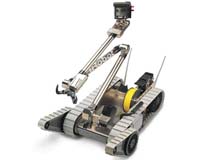
St. Louis (UPI) Aug 5, 2008 Military robots are no longer only science fiction, with the U.S. Army planning to have 30 percent of its forces composed of robots by 2020. Washington University Assistant Professor Bill Smart and doctoral student Doug Few said the Army's robots won't resemble robotic soldiers from movies such as "Star Wars" and "I, Robot." "When the military says 'robot' they mean everything from self-driving trucks up to what you would conventionally think of as a robot," said Smart, codirector of the university's Media and Machines Laboratory. "You would more accurately call them autonomous systems rather than robots." All of the Army's robotic force is teleoperated, meaning someone operates the robot from a remote location. "It's a chain of command thing," said Smart. "You don't want to give autonomy to a weapons delivery system." While movies display robots as intelligent beings, Smart and Few aren't necessarily looking for intelligent decision-making in their robots. Instead, they're working to develop an improved, "intelligent" functioning robot. "It's oftentimes like the difference between the adverb and noun," said Few. "You can act intelligently or you can be intelligent. I'm much more interested in the adverb for my robots." Community Email This Article Comment On This Article Share This Article With Planet Earth
Related Links The latest in Military Technology for the 21st century at SpaceWar.com
 Improvements In Thermal Management Of Future Electronics
 Linthicum MD (SPX) Aug 05, 2008
Northrop Grumman has been selected by the Defense Advanced Research Projects Agency (DARPA) to develop and demonstrate an ultra high capacity hybrid thermal ground plane needed to overcome heat-related challenges in semiconductors employed in electronic systems. |
|
|

| The content herein, unless otherwise known to be public domain, are Copyright 1995-2007 - SpaceDaily.AFP and UPI Wire Stories are copyright Agence France-Presse and United Press International. ESA Portal Reports are copyright European Space Agency. All NASA sourced material is public domain. Additional copyrights may apply in whole or part to other bona fide parties. Advertising does not imply endorsement,agreement or approval of any opinions, statements or information provided by SpaceDaily on any Web page published or hosted by SpaceDaily. Privacy Statement |
 del.icio.us
 Digg
Digg Reddit
 YahooMyWeb
 Google
 Facebook