|
 |
 |
 |
 |
 |
 |
 |
 |

 |
U.S. Takes First Step To Weaponize Space
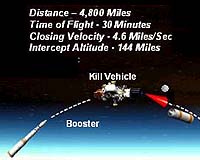
Washington (UPI) Mar 30, 2004 Washington's Missile Defense Agency has earmarked $68 million for what some believe is the first step for putting weapons in space, ABC News reported Tuesday. Known as the Near Field Infrared Experiment or NFIRE satellite, it is primarily designed to gather data on exhaust plumes from rockets launched from earth. As a result, military officials say the $68 million item in the 2005 budget is a defensive, rather than offensive project. But, critics point out, the satellite will also contain a smaller "kill vehicle," a projectile that takes advantage of the kinetic energy of objects traveling through low-Earth orbit (which move at several times the speed of a bullet) to disable or destroy an oncoming missile or another orbiting satellite. As one senior government official and defense expert, who requested anonymity, said, "We're crossing the Rubicon into space weaponization." All rights reserved. Copyright 2004 by United Press International. Sections of the information displayed on this page (dispatches, photographs, logos) are protected by intellectual property rights owned by United Press International. As a consequence, you may not copy, reproduce, modify, transmit, publish, display or in any way commercially exploit any of the content of this section without the prior written consent of by United Press International. Community Email This Article Comment On This Article Related Links SpaceDaily Search SpaceDaily Subscribe To SpaceDaily Express Learn about missile defense at SpaceWar.com Learn about nuclear weapons doctrine and defense at SpaceWar.com All about missiles at SpaceWar.com Learn about the Superpowers of the 21st Century at SpaceWar.com
 Missile Defense Program Moves Forward
 Washington DC (AFPS) Jan 12, 2006
The Missile Defense Agency continues to move forward in its efforts to protect the nation against a ballistic missile attack. The eighth ground-based interceptor missile was lowered into its underground silo at Fort Greely, Alaska, Dec. 18, 2005. |
|
|

| The content herein, unless otherwise known to be public domain, are Copyright 1995-2006 - SpaceDaily.AFP and UPI Wire Stories are copyright Agence France-Presse and United Press International. ESA PortalReports are copyright European Space Agency. All NASA sourced material is public domain. Additionalcopyrights may apply in whole or part to other bona fide parties. Advertising does not imply endorsement,agreement or approval of any opinions, statements or information provided by SpaceDaily on any Web page published or hosted by SpaceDaily. Privacy Statement |