|
 |
 |
 |
 |
 |
 |
 |
 |

 |
US Skeptical On Fajr-3 Claims
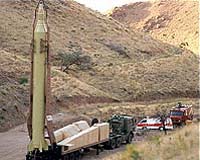
UPI Senior News Analyst Washington (UPI) Apr 06, 2006 The Pentagon is playing down Iran's claims that it has successfully tested a multiple warhead missile with stealth capabilities. The Iranian armed forces announced Friday that they had successfully test fired a Fajr-3 missile that could carry multiple warheads and that was not detectable by radar. The report was greeted with consternation, especially in Israel which has upgraded its Arrow anti-ballistic missile interceptor to cope with the threat of Iran's intermediate-range Shahab 3 missiles that can hit targets at least 620 miles away. Last December, an Israeli Arrow, co-produced by Israel Aircraft Industries and Boeing, successfully intercepted a missile configured to fly like a Shahab-3. Apart from the United States only Russia has successfully developed multiple independently targeted reentry vehicle, or MIRV, technology and anti-ballistic missile interceptor evasion capabilities on its latest upgraded Topol-M and Bulava ground-mobile and submarine-launched intercontinental ballistic missile systems. However, the Washington Times' veteran intelligence correspondent Bill Gertz reported Tuesday that U.S. officials believed the Iranian claims were wild exaggerations. Gertz cited a DOD official as confirming that the missile used in Friday's Iranian test was only a Shahab-2, the Iranian designation for the old short range Scud-C missile, which has a range of only 310 miles. "It was not a new missile as (the) Iranian press reported," Gertz wrote. Gertz also cited missile analyst Uzi Rubin as saying the Iranian description of the Fajr-3 sounded very much like the new Russian Iskander-3 missile, except for the independent targeting, which the Iskander-3 does not have.
Is Iran's carrier-killer a squib? Other Western analysts are being equally skeptical about the other claim the Iranians made to have developed a remarkable new underwater torpedo-missile with aircraft carrier-killing capabilities that can travel at four times the speed of current fast torpedoes. StrategyPage.com reported that the weapon was most likely a version of the Russian-built VA-111 Shkval rocket-torpedo. But while the Shkval is fast, "the Russians have not had any success convincing the world's navy that their rocket propelled torpedo is a real threat," the Web site said. "The attacking sub has to get relatively close (within 4.2 miles) to use it. Modern anti-submarine tactics focus on preventing subs from getting that close. For that reason, the Russians themselves tout the VA-111 Shkval torpedo as a specialized anti-submarine weapon for Russian subs being stalked by other subs," Strategy Page.com said. The Web site's analyst also noted that the Shkval remained an "essentially unguided" weapon. The attacking submarine that carried it had to be lined up directly at its target so that when the Shkval was launched from its torpedo tube its rocket motor could ignite and then propel it in a straight line. "Do the math, and you will see that there is little margin for error, or chance of success, with such a weapon. If the Iranians bought the Shkval technology from Russia, they got the bad end of the deal," the report said.
Source: United Press International Community Email This Article Comment On This Article Related Links - Learn about missile defense at SpaceWar.com All about missiles at SpaceWar.com
 Iran Test Fires Third Missile In A Week
 Tehran (AFP) Apr 06, 2006
Iran has successfully test-fired its third missile in week during war games in the Gulf, Iran's Arabic language satellite television Al-Alam reported Wednesday. |
|
|

| The content herein, unless otherwise known to be public domain, are Copyright 1995-2006 - SpaceDaily.AFP and UPI Wire Stories are copyright Agence France-Presse and United Press International. ESA PortalReports are copyright European Space Agency. All NASA sourced material is public domain. Additionalcopyrights may apply in whole or part to other bona fide parties. Advertising does not imply endorsement,agreement or approval of any opinions, statements or information provided by SpaceDaily on any Web page published or hosted by SpaceDaily. Privacy Statement |