|
 |
 |
 |
 |
 |
 |
 |
 |

 |
US Senate Acts Wisely On Hayden
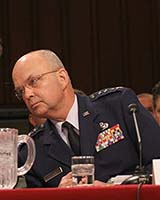
UPI Senior News Analyst Washington (UPI) May 23, 2006 The U.S. Senate has given the Bush administration an extended blank check on domestic electronic phone surveillance. As we predicted in these columns last week, the U.S. Senate confirmation hearings on Gen. Michael Hayden focused on data mining from U.S. domestic phone records during his tenure as head of the National Security Agency. But at no point did senators make any serious suggestion about imposing any new legal or congressional oversight procedures on the vastly extended surveillance programs that Hayden oversaw during his time running the super-secret NSA. The senators, as we predicted, focused narrowly on Hayden's record, and his performance before them defused, at least in the short term, many of the concerns that had been expressed on Capitol Hill about the long-term implications and dangers of the data mining program. The course of these hearings reveals several significant findings about current U.S. popular attitudes, as interpreted by the nation's elected representatives, on national security issues. First, despite President George W. Bush's tumbling approval ratings over the economy, national security and the war in Iraq, domestic surveillance powers remain the third rail of American politics. No one in the Republican or Democratic Party mainstreams wants to risk touching them for fear of getting electrocuted. In the short term, this has spared Bush yet more embarrassments. USA Today's report exposing the previously unsuspected extent of the NSA's data mining program on national phone records was discussed throughout the media and led to much initial criticism of the administration from Republican as well as Democratic senators. But it did not translate into any serious effort to insist that the programs be curtailed, or even that they should have congressional oversight procedures imposed upon them to prevent their abuse. For as we noted in these columns last week, major figures in neither party want to take the risk of exposing themselves to future criticism for reining in security surveillance programs in case they may be blamed at some point in the future for blocking the programs that could have prevented future mega-terrorist attacks as bad as, or worse than, those of Sept. 11, 2001. In this very basic sense, therefore, the traumas of Sept. 11, 2001, continue to be the driving force of American politics. Second, the revelations about the NSA data mining does not seem to have significantly further damaged Bush's opinion poll ratings, although since they were already in the low 30 percent range, they were already in the dog house. However much his credibility on Iraq has been destroyed, the American public still approves the general principle of empowering the U.S. domestic security services and intelligence agencies against potential terrorist threats. Third -- this is not particularly good news for Bush, however -- because recent polling data suggests that key centrist areas of American public opinion have already crossed the crucial barrier of trusting Bush to protect them against domestic and other national security threats better than anyone else. The public still wants any president to have those powers. But a clear majority of it no longer requires Bush above other political figures to exercise them. The American public continues to support giving the U.S. intelligence community wide-ranging powers of domestic surveillance to prevent another mega-terrorist attack like those of Sept. 11, 2001. And they also believe -- almost certainly with good reason -- that the exercise of these powers has significantly protected them since those earlier attacks. But they also believe that these additional surveillance powers can and will be exercised by future presidents, either Democratic or Republican, at least as well as, if not better than, has been done by Bush. Fourth, the senators tacitly expressed their continuing confidence in Gen. Hayden by not using their cross-examination of him about the surveillance powers as a reason to block his nomination to be the next director of the CIA. This was a sensible call for the senators to make as Gen. Hayden's track record and his actions since being nominated by President Bush to replace hapless Porter Goss as head of the long-troubled CIA suggest he is indeed by far the best available candidate for the challenging and thankless job. Hayden ran the NSA extremely well. And the talent pool available in the U.S. intelligence community for experienced executives who have run large U.S. security organizations well over the past decade is not a big one at all. Hayden's decision, backed by Director of National Intelligence John Negroponte, to bring back Stephen Kappes -- the widely respected former CIA Director of Operations -- as his Number Two after Goss forced Kappes out was rightly seen as a strong message that Hayden would listen to the best of the agency's intelligence veterans as he seeks to reform and revive it. In an ideal world, the Senate would have approved Gen. Hayden's nomination, agreed that the increased surveillance powers were necessary to combat the threats the United States still faced and also approved new oversight programs to make sure those surveillance powers were not abused. Two out of three wasn't a bad start.
Source: United Press International Community Email This Article Comment On This Article Related Links - The Long War - Doctrine and Application
 Bush Gets Border Mix Right
 Washington (UPI) May 23, 2006
The bad news last week was that President Bush badly underestimated the number of troops he will need to enforce border security with Mexico. The good news was that he got the balance of border security and good relations with Hispanic-Americans right. |
|
|

| The content herein, unless otherwise known to be public domain, are Copyright 1995-2006 - SpaceDaily.AFP and UPI Wire Stories are copyright Agence France-Presse and United Press International. ESA PortalReports are copyright European Space Agency. All NASA sourced material is public domain. Additionalcopyrights may apply in whole or part to other bona fide parties. Advertising does not imply endorsement,agreement or approval of any opinions, statements or information provided by SpaceDaily on any Web page published or hosted by SpaceDaily. Privacy Statement |