|
 |
 |
 |
 |
 |
 |
 |
 |

 |
US Policy Becoming Confused Over Iran Says Russia
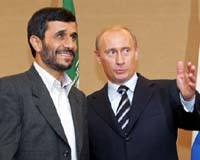
UPI Outside View Commentator Moscow (UPI) Jun 20, 2006 Things are getting curiouser and curiouser in the United States as encouraging news comes from Tehran in response to the latest six-party nuclear offer. The Bush administration seems to have been taken totally by surprise by new political advice that negotiations should be promoted and even that Iran, in fact, has some right to a local version of the nuclear cycle. Iranian President Mahmoud Ahmadinejad's Shanghai meeting with Russian President Vladimir Putin has ended in a declaration of Iran's readiness for talks -- which certainly adds weight to Russia's long-time calls for commitment to prudent and unbiased enforcement of the Nuclear Non-Proliferation Treaty and respect for all other commitments stemming from it; the Europeans and the Americans have suddenly emerged with surprisingly bright ideas on something they had earlier denied even thinking of. The Iranian leader's Shanghai promises are highly likely to broaden the divide in the U.S. political community. The hawkish faction will probably have to back down a little under pressure from "talks" people who have really big cards to play with. First, with the U.S. forces stuck in Iraq, the nation simply cannot afford another unpredictable military adventure. Second, they might add, some of Iran's new decision-makers seem savory enough for India-like negotiating with the possible outcome of Russians and Europeans being, slowly but surely, squeezed out of what will then turn into a new promising playground. True, the old "you can never trust the Russians, better try the West" approach is already circulating across Iranian society, especially among people who have relatives in the United States. This is what they call a true intrigue, one that makes Secretary of State Condoleezza Rice's dream come true -- finally the Russians are being labeled as "undependable partners" by Iranian ayatollahs, who used to be so loyal to them. But these subtleties are also exactly what diehard Republican conservatives despise Rice for, putting on her all the blame for "sluggish progress" on Iran. Although the gap between neocons and moderates is so narrow that any inconvenience with Iran -- for example, a single Ahmadinejad offensive remark on Israel -- might prompt most moderates to suddenly turn hawkish, some of the turns and twists of the U.S.-Iran nuclear debate are truly remarkable. There seems to be a consensus on describing the ideology-driven President Ahmadinejad as the greatest obstacle to a possible Washington-Tehran deal. Ahmadinejad is popular with the Iranian youth -- not the urban yuppies craving for Western mass culture but the poor rural Muslim people who appreciate his youth development programs. So the U.S. intelligence people, well aware that the president is foreign to the narrow group of nuclear decision-makers, wonder how then he managed to win the election against the rich and powerful Akbar Hashemi Rafsanjani. The obvious American question here is "where's the money?" To some, the answer is very easy and simple: it's the Russians again. If anyone sees a "Russian oil money propelled Ahmadinejad to power" headline in a U.S. newspaper tomorrow, they should look no further than this essay. Ridiculous? We have seen more ridiculous things, thank you very much, that were printed and sold as perfectly true. Meanwhile, United States Director of National Intelligence John D. Negroponte and Rice are setting up their own Iran think tanks, including a special office on Iran at the State Department. While this is a sign of hope that the military option is currently not the first on the table, and what Ahmadinejad told Putin in Shanghai sounds plausible enough, everyone needs to do more. Iran, for its part, should move faster to walk the walk on its deliberations with the "Iranian Six." Dragging out the issue would clearly not be in its best interests as it would play straight into the hands of the hawks over the Atlantic. (Lt. Gen. Gennady Yevstafyev, Ret., is a former senior officer of Russia's Foreign Intelligence Service, also known as the SVR. He is now a senior adviser at the Center for Policy Studies in Russia or PIR Center. This article is reprinted by permission of RIA Novosti) (United Press International's "Outside View" commentaries are written by outside contributors who specialize in a variety of important issues. The views expressed do not necessarily reflect those of United Press International. In the interests of creating an open forum, original submissions are invited.)
Source: United Press International Community Email This Article Comment On This Article Related Links - Learn about nuclear weapons doctrine and defense at SpaceWar.com Learn about missile defense at SpaceWar.com All about missiles at SpaceWar.com Learn about the Superpowers of the 21st Century at SpaceWar.com
 US And Russian Nuclear Weapons Deal Extended
 Washington (AFP) Jun 20, 2006
The United States and Russia have extended the US-funded program that pays for the dismantling of weapons of mass destruction inherited by Russia from the former Soviet Union, the White House said Monday. |
|
|

| The content herein, unless otherwise known to be public domain, are Copyright 1995-2006 - SpaceDaily.AFP and UPI Wire Stories are copyright Agence France-Presse and United Press International. ESA PortalReports are copyright European Space Agency. All NASA sourced material is public domain. Additionalcopyrights may apply in whole or part to other bona fide parties. Advertising does not imply endorsement,agreement or approval of any opinions, statements or information provided by SpaceDaily on any Web page published or hosted by SpaceDaily. Privacy Statement |