|
 |
 |
 |
 |
 |
 |
 |
 |

 |
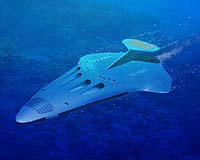
US Navy Submarine Makes First Launch Of Underwater Glider
Pearl Harbor HI (SPX) Nov 24, 2005 In a first for the U.S. Navy, an underwater glider was launched with the aid of Navy divers from the Dry Deck Shelter aboard USS Buffalo (SSN 715) November 14. The glider is a uniquely mobile network component capable of moving to specific locations and depths and gathering various information, which is transmitted on a predetermined interval when it surfaces to computers via a built-in satellite phone. "Our interest in the submarine force has been to use these to characterize the ocean," explained Lt. Cmdr. Patrick Cross, Pacific Submarine Force oceanographer. "They're equipped with sensors that can give us [readings on] salinity and temperature versus depth, and from that we can get sound speeds (the localized rate at which sound from a source travels through water). We can feed that data into our MODAS (Modular Ocean Data Assimilation System), run by the Naval Oceanographic Office, and that provides a picture that we provide to our submarines," said Cross. The battery-powered device paints a picture for assets below and above the ocean that can be used to their advantage, according to Cross. "It's basically a three dimensional depiction of ocean conditions that is used in tactical decision aids to determine sonar performance," said Cross. "The gliders are a great way to have a persistent sensor out there to continuously feed us data on what the ocean is doing," he said. "Then we can feed that to our shore-based computer models and get a better picture of the ocean and give that information to all tactical assets - not just submarines, but anyone involved in ASW (anti-submarine warfare)." Cross added that the gliders have demonstrated their capability in various exercises. "We have had incremental success since we began using them in exercises, including a glider in RIMPAC (exercise Rim of the Pacific) '04," he said. "It did a great job of demonstrating the technology." Retrieving a glider via submarine is a logical next step. "One of the future exercises we hope to do is recover a glider on board a submarine, demonstrating both deployment and recovery. We would locate the glider via GPS, and divers would retrieve it and bring it aboard," Cross said. The gliders are relatively inexpensive, easy to reconfigure for various missions, and have a long life span with minimal maintenance required. When new batteries are required, they can simply be replaced and the glider can be put back in the water again. Community Email This Article Comment On This Article Related Links SpaceDaily Search SpaceDaily Subscribe To SpaceDaily Express The latest in Military Technology for the 21st century at SpaceWar.com
 Polish Defense Ministry Procures Elisra's EJAB For Its Forces In Iraq
 Bene-Berak, Israel (SPX) Jan 09, 2006
Elisra Electronic Systems, a member of The Elisra Group, has received an order estimated at $3 million from the Polish Ministry of Defense for its unique EJAB system. |
|
|

| The content herein, unless otherwise known to be public domain, are Copyright 1995-2006 - SpaceDaily.AFP and UPI Wire Stories are copyright Agence France-Presse and United Press International. ESA PortalReports are copyright European Space Agency. All NASA sourced material is public domain. Additionalcopyrights may apply in whole or part to other bona fide parties. Advertising does not imply endorsement,agreement or approval of any opinions, statements or information provided by SpaceDaily on any Web page published or hosted by SpaceDaily. Privacy Statement |