|
 |
 |
 |
 |
 |
 |
 |
 |

 |
US National Lab And Surrey Satellite Contract For Cibola Experiment
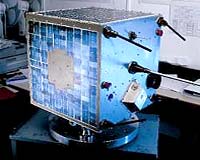
Los Alamos - Mar 12, 2004 Los Alamos National Laboratory and Surrey Satellite Technology Limited (SSTL) have announced a contract agreement for development of an advanced satellite platform for ionospheric and lightning studies. The British firm, SSTL, will create the satellite platform that will be used to carry the Cibola Flight Experiment payload developed by Los Alamos. The contract with SSTL is valued at $11.8 million. Los Alamos, operated by the University of California for the U.S. National Nuclear Security Administration, is building the Cibola Flight Experiment (CFE), a reconfigurable processor payload intended for a low-Earth orbit system. It will survey portions of the VHF and UHF radio spectra. The experiment uses networks of reprogrammable, field programmable gate arrays (FPGAs) to process the received signals for ionospheric and lightning studies. The objective is to detect and measure impulsive events that occur in a complex background. The experiment also will validate the on-orbit use of commercial, reconfigurable FPGA technology demonstrating several different schemes for the mitigation and correction of "single-event upsets" that would crash most current computer systems. The U.S. Department of Defense Space Test Program (STP) is including the Cibola Flight Experiment satellite as part of the STP-1 space flight mission. The STP-1 mission goal is to provide space-flight opportunity for a maximum number of DoD Space Experiments Review Board payloads on a single launch. The DoD Space Test Program is responsible for the integration of seven satellites into a single payload stack and launch of the STP-1 mission. The STP-1 mission is scheduled for launch in 2006 on a medium-class Lockheed-Martin Atlas-V, a U.S. Air Force Evolved Expendable Launch Vehicle (EELV), using the EELV's Secondary Payload Adapter that allows small satellites to be launched as "piggyback" passengers with larger spacecraft. Timothy Murphy, head of research and development during the selection process in the International, Space and Technology Division at Los Alamos, said "It will be essential that our payload's partners can meet our schedule with a flight-proven satellite platform that we are confident will be flight-ready in time for the EELV launch." Commenting on the contract award, SSTL's Chief Executive Officer, Sir Martin Sweeting said, "The award of this contract is great news for SSTL. SSTL has already supplied satellite platforms to the U.S. government, most notably PicoSat for the U.S. Air Force. Three of SSTL's flight-proven satellite platforms are in NASA's Rapid II catalogue and the award of this contract maintains SSTL as the leading non- U.S. supplier of microsatellites in the very important U.S. marketplace. We shall work hard to ensure the project is a resounding success." SSTL's satellite platform is based upon its proven microsatellite bus that has now flown 23 times. In September 2003, three satellites of SSTL's disaster monitoring constellation (DMC) were launched and commissioning of all three satellites is proceeding to plan. The Cibola platform draws heavily on the engineering performed on the DMC satellites and also on the TopSat mission due for launch late in 2004. DMC and TopSat were two of the three missions funded by the British National Space Centre's initiative for small satellites known as MOSAIC. Community Email This Article Comment On This Article Related Links Surrey Satellite Technology SpaceDaily Search SpaceDaily Subscribe To SpaceDaily Express Microsat News and Nanosat News at SpaceMart.com
 Small Satellite Solutions From Scotland
 Clyde, Scotland (SPX) Jan 12, 2006
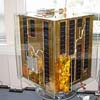
Clyde Space are offering the growing ranks of small satellite manufacturers power subsystem solutions for their missions. Based in purpose built facilities on West of Scotland Science Park in Glasgow, Clyde Space has a range of power subsystems for missions from as little as 1W up to in excess of 2.5kW. |
|
|

| The content herein, unless otherwise known to be public domain, are Copyright 1995-2006 - SpaceDaily.AFP and UPI Wire Stories are copyright Agence France-Presse and United Press International. ESA PortalReports are copyright European Space Agency. All NASA sourced material is public domain. Additionalcopyrights may apply in whole or part to other bona fide parties. Advertising does not imply endorsement,agreement or approval of any opinions, statements or information provided by SpaceDaily on any Web page published or hosted by SpaceDaily. Privacy Statement |