|
 |
 |
 |
 |
 |
 |
 |
 |

 |
US Finance Chief Takes Reform Campaign To China
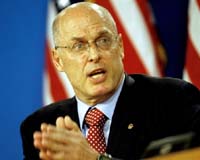
Singapore (AFP) Sep 18, 2006 New US Treasury Secretary Henry Paulson was due in China Tuesday to lobby for far-reaching economic reform, hoping to capitalise on a formidable list of contacts amassed when he was on Wall Street. But Chinese leaders, who know Paulson well from his seven years as boss of investment banking giant Goldman Sachs, show every intention of biding their time. With elections for Congress looming in November, Paulson is under pressure to return from his four-day trip with concrete results on disputes including China's exchange rate, market access and fake goods. However, as he prepares to visit China for the first time since leaving Goldman Sachs to become Treasury chief in July, Paulson is warning China's critics not to expect a "quick fix". Speaking here at annual meetings of global financial leaders over the weekend, he said it would be "presumptuous" for him to dictate a specific exchange rate to the world's fourth largest trading power. But in Singapore, the United States has pressed for the International Monetary Fund to take a bolder role in policing global exchange rates to ensure that no country gains an unfair trade edge. "The IMF houses great technical expertise, capable of carrying out this task," Paulson told an IMF meeting Sunday. "But if the Fund does not do the job, pressures will mount on individual countries to do so, to the detriment of all countries." Once back in Washington, Paulson's team will begin crafting a twice-yearly report on exchange rate policies. Despite fierce pressure from Congress, the Treasury has so far refrained from labelling China a currency "manipulator". Many US lawmakers and some economists argue that the yuan is undervalued by as much as 40 percent against the dollar, giving an artificial boost to Chinese exports at the cost of millions of American factory jobs. Without meaningful currency reform, the US Senate could well hold a vote this month on a bill that would slap a punitive tariff of 27.5 percent on all of China's US-bound goods. But Paulson is pressing for a much wider debate on the need for a transformation of China's economy away from its breakneck, export-led growth, both for its own good and for that of the global system. In China, Paulson was expected to hold talks with top leaders including President Hu Jintao, meet local business leaders and face University of Beijing students for a US-style "town hall" debate. His trip was to start with a meeting in the southern city of Hangzhou with Zhejiang province's communist party chief Xi Jinping, an old friend from his Goldman Sachs days whom Washington sees as a champion of reform in China. The United States wants China to drastically overhaul its financial markets and release the shackles constraining domestic growth, while also elevating the country to the top tables of global economic decision-making. The Singapore meetings of the Group of Seven powers and the IMF have been dominated by talk of the need to redress global imbalances arising from China's headlong growth. As China has flooded world markets with its exports, so the US current account deficit has exploded. That worries policymakers, in the event that the dollar crashes or flagging US growth grinds to a halt. China's central bank governor Zhou Xiaochuan, who was due to have a private dinner with Paulson later Monday, believes the global imbalances are a shared responsibility for all the big economic players. At the IMF meetings, Zhou said China would continue with gradual moves towards more currency flexibility, but that the country was still working on long-running reform of its banking and financial sectors.
Source: Agence France-Presse Community Email This Article Comment On This Article Related Links The Economy The Economy
 China To Limit Foreign Investment In Shipyards
 Beijing (XNA) Sep 19, 2006
China plans to cap foreign holdings in the country's ship makers at 49 percent as the government moves to both maintain control over the fledgling industry and tap overseas know how. |
|
|

| The content herein, unless otherwise known to be public domain, are Copyright 1995-2006 - SpaceDaily.AFP and UPI Wire Stories are copyright Agence France-Presse and United Press International. ESA PortalReports are copyright European Space Agency. All NASA sourced material is public domain. Additionalcopyrights may apply in whole or part to other bona fide parties. Advertising does not imply endorsement,agreement or approval of any opinions, statements or information provided by SpaceDaily on any Web page published or hosted by SpaceDaily. Privacy Statement |