|
 |
 |
 |
 |
 |
 |
 |
 |

 |
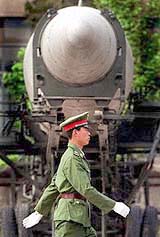
US Extends Waiver Of Missile Proliferation Sanctions On China
Washington (AFP) Mar 22, 2005 The United States has extended a waiver of missile proliferation sanctions against certain Chinese government activities, the State Department said Tuesday. "On March 17, we extended for another six months the waiver of import penalties against certain Chinese government activities under the missile sanctions law," the official told AFP, speaking on condition of anonymity. The waiver was in connection with missile sanctions that were imposed in September 2003 against the state-run China North Industries Incorporated (NORINCO), the official said. NORINCO was accused of selling advanced missile technology to an unnamed state. The company had in the past been punished for sales to Iran. "The waiver of the import ban under the missle sanctions law was extended because it was essential to the national security of the United States to do so," the US official said, without elaborating. "It will not be appropriate to comment further concerning the extension of the import ban waiver." Sanctions, which were first imposed after it was discovered China had sold missile technology to Pakistan and other states, were first waived in September last year for six months. The sanctions were linked to "the development or production of any missile equipment or technology and activities of the Chinese government affecting the development or production of electronics, space systems or equipment, and military aircraft," according to an official notice issued last week. The waiver extension came just before Secretary of State Condoleeza Rice visited Beijing and held talks with Chinese leaders amid concerns over China's arms buildup. The United States has been repeatedly urging the European Union against lifting an arms embargo on China, imposed after the brutal Tiananmen Square crackdown on democracy demonstrators in 1989. Washington argued that any easing of the ban would send Beijing the wrong message on human rights and alter the regional military balance. Their case took on added urgency after China's parliament adopted a law on March 14 authorizing the use of force if necessary to stop Taiwan from seceding from the mainland. Community Email This Article Comment On This Article Related Links SpaceDaily Search SpaceDaily Subscribe To SpaceDaily Express Learn about missile defense at SpaceWar.com All about missiles at SpaceWar.com
 Northrop Grumman Wins Contract For Target And Space-Launch Missile Work
 Reston VA (SPX) Jan 12, 2006
Northrop Grumman has been awarded a follow-on contract to provide technical support to the U.S. Air Force's Rocket Systems Launch Program (RSLP). |
|
|

| The content herein, unless otherwise known to be public domain, are Copyright 1995-2006 - SpaceDaily.AFP and UPI Wire Stories are copyright Agence France-Presse and United Press International. ESA PortalReports are copyright European Space Agency. All NASA sourced material is public domain. Additionalcopyrights may apply in whole or part to other bona fide parties. Advertising does not imply endorsement,agreement or approval of any opinions, statements or information provided by SpaceDaily on any Web page published or hosted by SpaceDaily. Privacy Statement |