|
 |
 |
 |
 |
 |
 |
 |
 |

 |
US Draws Line In Anti-Nuke Drive At Uranium Enrichment
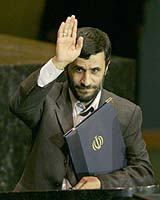
United Nations (AFP) Sep 19, 2005 In its drive to end the nuclear threat from North Korea and Iran, the United States has conceded their right to civilian atomic energy but appears to be drawing the line at sensitive fuel work. US officials insist the two cases are worlds apart, representing different cultures, mentalities and levels of nuclear capacity: North Korea likely has atomic bombs, Iran is years away. But in both disputes, Washington started out with a demand that they scrap all nuclear activities and came around to the fact there was little means or world support to deny them access to peaceful atomic programs. US Secretary of State Condoleezza Rice explicitly acknowledged last week that Washington had shifted its position vis-a-vis Iran and recognized its right to develop nuclear power but not a bomb. "What we don't want to do is give the impression that we don't think that Iran should be a technologically sophisticated state," Rice told the New York Post. "What we don't want is for them to have technological sophistication that leads to a bomb. That's the issue," she said. The Americans have been steadfast in their efforts to deprive Iran and North Korea of the capacity to enrich uranium, which is a staple fuel in reactors but can also be used in nuclear bombs. They said Iran's new President Mahmoud Ahmadinejad changed the debate when he delivered a hardline speech Saturday to the UN General Assembly affirming his country's "inalienable right" to have access to fuel-cycle work. A senior US official, who asked not to be named, described the speech as "a very big turn of events" that would likely harden attitudes as the UN nuclear watchdog opened a crucial meeting on Iran in Vienna on Monday. He said the Iranians had crossed a "redline" on the enrichment issue set by European negotiators who had hoped to use economic and security incentives to persuade Tehran to renounce any nuclear arms ambitions. The United States also appeared to have shifted ground to obtain Monday's breakthrough agreement by North Korea to give up its nuclear weapons in exchange for pledges of aid and security. Through exhausting rounds of talks that resumed in July, chief US negotiator Christopher Hill had insisted that North Korea had to "get out of the nuclear business" completely. On Monday he sounded a different note. "What we have made clear is that we will have a discussion on the issue of peaceful nuclear energy, and in particular the subject of the provision of a light water reactor, but only at an appropriate time," Hill said. The Americans sought to shelve any such negotiations until North Korea signed back on to the nuclear Non-Proliferation Treaty (NPT) it abandoned in January 2003 and was again under international inspection safeguards Under the accord reached in six-party talks in Beijing, Pyongyang "committed to abandoning all nuclear weapons and existing nuclear programs and returning at an early date" to the NPT. But asked about work on the nuclear fuel cycle, which includes uranium enrichment as well as the extraction of weapons-grade plutonium, Hill said "we haven't gotten into questions like that." Analysts such as Henry Sokolski, executive director of the Nonproliferation Policy Education Center, said part of the problem was the language of the 35-year-old NPT, which allows such activities to members in good standing. "The way it's being interpreted today, where everyone has a right to get within several days of having an arsenal force of weapons-usable material, turns the treaty on its head," Sokolski told the Council on Foreign Relations in April. If the North Korea and Iran negotiations were proceeding separately, officials still saw at least a diplomat link. British Foreign Secretary Jack Straw said the North Korean breakthrough showed "that isolation and defiance of the international community does not work, however fanciful individual nations may think that it can work." "And I think that's a good augury for the discussions which are now about to begin in Vienna at the board of directors of the IAEA (International Atomic Energy Agency)" concerning Iran, he said. Community Email This Article Comment On This Article Related Links SpaceDaily Search SpaceDaily Subscribe To SpaceDaily Express Learn about nuclear weapons doctrine and defense at SpaceWar.com Learn about missile defense at SpaceWar.com All about missiles at SpaceWar.com Learn about the Superpowers of the 21st Century at SpaceWar.com
 World Powers Threaten Defiant Iran Over Nuclear Crisis
 Vienna (AFP) Jan 11, 2006
World powers threatened Iran with UN Security Council sanctions Wednesday after it resumed sensitive nuclear activities as a defiant Tehran vowed to press ahead with its disputed atomic programme. |
|
|

| The content herein, unless otherwise known to be public domain, are Copyright 1995-2006 - SpaceDaily.AFP and UPI Wire Stories are copyright Agence France-Presse and United Press International. ESA PortalReports are copyright European Space Agency. All NASA sourced material is public domain. Additionalcopyrights may apply in whole or part to other bona fide parties. Advertising does not imply endorsement,agreement or approval of any opinions, statements or information provided by SpaceDaily on any Web page published or hosted by SpaceDaily. Privacy Statement |