|
 |
 |
 |
 |
 |
 |
 |
 |

 |
US Considers New Nuclear Generation 60 Years After First Bomb
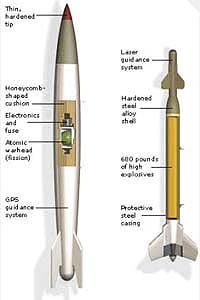
Washington (AFP) Jul 26, 2005 Sixty years after the first atomic bomb was tested in the New Mexico desert, the United States still has some 2,000 nuclear weapons on hair trigger alert and is considering new weapons such as earth-penetrating bunker busters. The US administration has agreed to pare back its nuclear arsenal from about 10,000 warheads today to about 6,000 in 2012 under the Moscow Treaty reached with Russia in 2001. But even as it moves to retire much of its Cold War arsenal, it has pressed a reluctant Congress for funds for nuclear bunker-buster studies, refurbished nuclear testing facilities, and a facility to build the plutonium triggers for new weapons. The US Strategic Command in Omaha, Nebraska, is reported to be developing "global strike" options, including a nuclear option, against potential adversaries with nuclear weapons such as Iran and North Korea. More than 15 years after the fall of the Berlin Wall, nuclear weapons "are alive and well," said Robert S. Norris, an expert at the Natural Resources Defense Council, an arms control and environmental advocacy group. Norris points to the administration's Nuclear Posture Review of 2001 as "the revealing document" that shows its intention to use nuclear weapons to counter a new cast of potential adversaries armed with weapons of mass destruction. The review called for a "new triad" in which conventional and nuclear forces would be meshed in a "global strike" capability, enabling the United States to respond to a threat anywhere in the world on very short notice. It envisioned more precise long-range missiles armed with conventional warheads as well as smaller, lower yield nuclear tips. The other parts of the triad are missile defense systems and a revived infrastructure of weapons labs and production facilities that had deteriorated since the end of the Cold War. "So the vision of the Bush administration is that we are going to need nuclear weapons well out into the middle of the 21st century, and beyond. I mean for decades to come," said Norris. But the administration appears not to have counted on Representative David Hobson. The Ohio Republican, chairman of the House Appropriations subcommittee that oversees the Energy Department's nuclear weapons programs, stunned the administration by rejecting last year's request for new nuclear weapons funding. He nixed nine million dollars in funding for research into new low yield "mini-nukes;" denied another 27.6 million dollars request for study of a Robust Nuclear Earth-Penetrating Weapon; and put off a request for another 30 million dollars for a new plant to manufacture the plutonium pits that trigger nuclear explosions. "The development of new weapons for ill-defined future requirements is not what the nation needs at this time," Hobson said in a speech February 3 to the Arms Control Association. "What is needed, and what is absent to date, is leadership and fresh thinking for the 21st Century regarding nuclear security and the future of the US stockpile," he said. The United States currently has 5,300 operational nuclear warheads, and another 5,300 in reserve, said Victoria Sampson, an expert at the Center for Defense Information. "We have about 2,000 which are on hair trigger alert, which means they can be ready to go within minutes of that decision to launch," she said. Hobson and others are worried that new nuclear weapons initiatives could lower the threshhold for their use, and warned it would send the wrong signal at a time when the United States was demanding that North Korea and Iran stop their weapons programs. But the administration has struck back with a request for 8.5 million dollars of renewed funding for the nuclear earth penetrator in 2006. It also has asked for 25 million dollars to get its Nevada test site ready to resume testing in 18 months if needed, instead of the 24 to 36 months it would currently take. Those requests are working their way through Congress where opposition remains strong. Defense Secretary Donald Rumsfeld argued that only "very large, very dirty nuclear bombs" could now destroy the increasing numbers of facilities that potential adversaries have buried deep underground. "So the choice is: do we want to have nothing and only a large, dirty nuclear weapon, or would we rather have something in between. That is the issue," he said in April. "It seems to me studying it makes all the sense in the world," he said. But scientists warn that no earth-penetrating nuclear weapon could bore deep enough to trap devastating fallout that the National Academy of Sciences has concluded would still kill more than a million people on the surface if it was near a densely populated urban area. Community Email This Article Comment On This Article Related Links SpaceDaily Search SpaceDaily Subscribe To SpaceDaily Express Learn about nuclear weapons doctrine and defense at SpaceWar.com Learn about missile defense at SpaceWar.com All about missiles at SpaceWar.com Learn about the Superpowers of the 21st Century at SpaceWar.com
 World Powers Threaten Defiant Iran Over Nuclear Crisis
 Vienna (AFP) Jan 11, 2006
World powers threatened Iran with UN Security Council sanctions Wednesday after it resumed sensitive nuclear activities as a defiant Tehran vowed to press ahead with its disputed atomic programme. |
|
|

| The content herein, unless otherwise known to be public domain, are Copyright 1995-2006 - SpaceDaily.AFP and UPI Wire Stories are copyright Agence France-Presse and United Press International. ESA PortalReports are copyright European Space Agency. All NASA sourced material is public domain. Additionalcopyrights may apply in whole or part to other bona fide parties. Advertising does not imply endorsement,agreement or approval of any opinions, statements or information provided by SpaceDaily on any Web page published or hosted by SpaceDaily. Privacy Statement |