|
 |
 |
 |
 |
 |
 |
 |
 |

 |
U.S.: China Currency Float 'First Step'
Washington (UPI) Jul 22, 2005 After months of U.S. pressure on China to revalue its currency, the Chinese government agreed Thursday to appreciate its currency, immediately ending a decade-old peg to the U.S. dollar. The People's Bank of China announced it would float its exchange rate not only against the dollar, but other currencies as well. The bank agreed to revalue the yuan to 8.11 from 8.28, strengthening the currency by 2 percent. However, the Chinese government denied U.S. pressure prompted the decision. In fact, it argued measures being discussed on Capitol Hill, which Beijing has labeled protectionist, had impeded efforts by China to make the necessary economic reforms earlier. "The U.S. pressure can only be counterproductive, it actually delayed our measure," Jun Tian, counselor of economic affairs at the Chinese Embassy in Washington, told United Press International. "We understand what is going on the Hill is pure politics. It is not an economic matter." According to the Embassy, China's economy has witnessed a cooling-off period with inflation rates plummeting and increased trade surpluses over the past several months. Despite U.S. pressure, the Embassy said the Central Bank believed it was the appropriate time to take action to reduce "the need for sterilizing the capital inflow and the impact of speculative money flow." "Based on the need for macro-economic management in China, the Central Bank has decided to appreciate their currency a little bit and at the same time start the reform of our exchange regime, not to be based on the relationship with the dollar itself but to several currencies as its benchmark," said Tian. China has faced pressure from the U.S. Congress to revalue its currency. Congressional leaders have argued cheap wages and the pegged currency had caused the current $162 billion trade deficit with China, the largest trade imbalance between two countries. China rebutted the U.S. argument. It said the U.S. trade deficit was caused by the country's low savings rating, adding that because of the 2000 collapse of the U.S. stock market, direct investment in the United States was no longer attractive, leaving the trade deficit a major avenue to channel foreign savings. "Most of the American economists agree that the U.S. trade deficit is a structural problem with the U.S. economy," said Tian. "There is no relation to foreign currency and at the same time the appreciation of the Chinese currency would not help to reduce the U.S. trade deficit." While Washington has engaged in negotiations with the Chinese government to make reforms and has threatened a 27.5 percent import tariff on all U.S. imports of Chinese goods, it called Thursday's move by China "a first step." "This is a good first step, albeit a baby step," said Sen. Charles Schumer, D-N.Y., the co-sponsor of the China Free Trade Act bill, at a hearing of the Senate Banking Committee Thursday. "It's smaller than we had hoped, but to paraphrase the Chinese philosophers, a trip of a thousand miles can well begin with the first baby step." The decision by China to revalue its currency was welcomed by Senators who were relieved they could avoid using U.S. legislation as retaliatory action. "It's good news that we were able to make progress in this area without resorting to legislating a punitive retaliatory tariff scheme like some were advocating," said Sen. Chuck Grassley, R-Iowa, chairman of the committee on finance, in a statement. "Such a scheme could have severely harmed confidence in the global marketplace, disrupted well-established trade flows, and potentially undercut worldwide economic growth." The U.S. Chamber of Commerce, which has been a strong opponent of any U.S. legislation, applauded China's decision, arguing a gradual action to revalue the yuan would help economic development and strengthen U.S.-China relations. "Continued movement toward a fully flexible exchange rate will also remove a major barrier to stronger U.S.-China commercial and economic relations," said Thomas Donahue, president of the U.S. Chamber of Commerce. The U.S. Department of Treasury said it would continue to monitor the situation. "We will monitor China's managed float as their exchange rate moves to alignment with underlying market conditions," said U.S. Treasury Secretary John Snow. Community Email This Article Comment On This Article Related Links SpaceDaily Search SpaceDaily Subscribe To SpaceDaily Express China News from SinoDaily.com
 China Wants To Expand Sino-US Military Relations
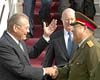 Beijing (AFP) Jan 10, 2006
China is ready to expand its military relations with the United States, Chinese Defense Minister Cao Gangchuan said on Tuesday. |
|
|

| The content herein, unless otherwise known to be public domain, are Copyright 1995-2006 - SpaceDaily.AFP and UPI Wire Stories are copyright Agence France-Presse and United Press International. ESA PortalReports are copyright European Space Agency. All NASA sourced material is public domain. Additionalcopyrights may apply in whole or part to other bona fide parties. Advertising does not imply endorsement,agreement or approval of any opinions, statements or information provided by SpaceDaily on any Web page published or hosted by SpaceDaily. Privacy Statement |