|
 |
 |
 |
 |
 |
 |
 |
 |

 |
US Charts Junkyard In The Heavens
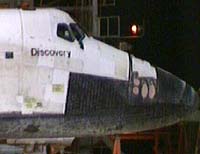
Washington (UPI) May 24, 2005 Whoever controls the high ground of near-Earth space potentially controls the world - but you'd better be a careful driver, for the space freeways of low Earth orbit are filled with man-made junk and there is more gathering there all the time. NORAD, the North American Aerospace Defense Command, currently tracks 13,000 man-made objects in space on a continual basis, of which only 6 percent are satellites. The endless monitoring is carried out by the 1st Space Control Squadron of the U.S. Air Force's Space Command in Colorado Springs, Colo. The amount of debris, in fact, is far larger than that. "Space Command only tracks objects larger than a baseball," Theresa Hitchens, director of the Center for Defense Information in Washington, told United Press International. "But there are between 100,000 and 200,000 pieces of space debris it doesn't track between the size of a baseball and a marble - and there are literally millions of smaller bios of debris than that." Hitchens said NASA released a study earlier this year warning that the chances of the International Space Station or the Space Shuttle sufferingn a catastrophic accident from a collision with a piece of orbiting man-made space debris "is only one in 200. That's a shocking number. They hope to bring the figure down to a one-in-600 chance." Collisions between man-made objects in space happen all the time. In 1999, the Space Shuttle Discovery landed with evidence of 64 impacts on its body. At least 10 of them, NASA concluded, were caused by such debris, although the objects in question were small. No shuttle has ever been struck in orbit by anything larger than 0.08 inches in diameter. Sometimes, though, larger space artifacts collide. Last Jan. 17, the engine from an American Thor missile launched back in 1974 met over Antarctica with a fragment of a Chinese rocket that blew up five years ago. Apart from the embarrassment, the joining of those pieces of orbiting hardware was harmless, but not all such events may be. For example, around one ton of radioactive fuel has been launched aboard various satellites into low Earth orbit, or LEO, until the practice was discontinued in 1988, according to a recent report from the Fourth European Conference on Space Debris at the European Space Agency's operations center in Germany. The National Aeronautics and Space Administration's Orbital Debris Program at the Johnson Space Center in Houston is the world's leading organization monitoring the near-space environment and in developing what it calls "mitigation measures" to protect space users in orbit. The problems likely will grow a lot worse, with even global warming contributing to the situation. The British Broadcasting Corporation reported May 5 that scientists at Southampton University have discovered increased carbon dioxide, or CO2, levels in the atmosphere caused by greenhouse gases are causing a cooling at high altitudes that is lowering atmospheric density. The good news about this is orbiting satellites will be able to stay up in LEO - around 300 kilometers or 180 miles above Earth - for significantly longer periods of time. The bad news is all that space junk will stay up a lot longer, too, and with it a bigger risk of collisions that could cause disabling or catastrophic damage to orbiting satellites or even manned space vehicles such as NASA's space shuttle. "The lower density causes all objects to stay in orbit for longer, so if you have a collision that produces debris, the pieces go off in their various orbits and produce more collisions. It's like a chain reaction," Graham Swinerd of the University of Southampton told BBC News. Swinerd and colleagues unveiled this bad news in a paper they presented at the European space-debris conference. Until recently, space collisions were only a rarely documented phenomenon. The first observed one occurred in 1996 when the French Cerise satellite hit a fragment from an Ariane rocket. NASA's Orbital Debris Program office, however, has discovered that in late December 1991, a non-functional Russian navigational satellite, Cosmos 1934, collided with a piece of debris another Russian satellite, Cosmos 926. The U.S. Space Surveillance Network, or SSN, discovered debris from Cosmos 1934 within a few weeks of the event, but the fact of the collision was only discovered earlier this year when SSN scientists examined historical tracking data, Orbital Debris Quarterly reported in its most recent issue. Such collisions soon may become a lot less unusual. The reduced-density model the British scientists have developed predicts there may be at least 50 more such collisions by the end of the 21st century. Satellites are relatively small, but orbital velocities in LEO and, indeed, up to as high as 1,200 miles, are around 17,000 miles an hour. That means two objects colliding would do so with a combined velocity of up to about 34 times the speed of a rifle bullet. Communications satellites are much less likely to face this danger because they are sent to much higher, geosynchronous, or GEO, orbits at 21,600 miles above Earth. For LEO-range satellites, however, which includes militarily crucial surveillance spacecraft, increased shielding to protect them may be necessary, and that would be certain to increase the amount of fuel and therefore the costs of launching them. The United Nations takes the problem seriously, too, but it moves at a glacial pace. The Scientific and Technical Subcommittee of the UN's Committee on the Peaceful Uses of Outer Space (COPUOS hosts an annual discussion on space debris. The most recent one, in Vienna, Austria from Feb. 28 to March 4) decided to create internationally approved guidelines to approach the problem, but the guidelines are not even scheduled to be submitted to the STSC, let alone the full UN COPUOS, for at least another two years. In the meantime, the situation can only worsen. In less than half a century since the launch of the first man-made orbiting satellite - the Soviet Union's Sputnik I in 1957 - humanity has not yet turned the near heavens into hell, but it certainly has transformed it into a junkyard. "Right now, we have no way of cleaning up space," Hitchens said. "It would be nice to put a giant vacuum cleaner up there - but we can't." Community Email This Article Comment On This Article Related Links SpaceDaily Search SpaceDaily Subscribe To SpaceDaily Express Space Tourism, Space Transport and Space Exploration News
 NASA Refines Design For Crew Exploration Vehicle
 Washington DC (SPX) Jan 12, 2006
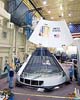
NASA's Constellation Program is making progress toward selecting a prime contractor to design, develop and build the Crew Exploration Vehicle (CEV), America's first new human spacecraft in 30 years. |
|
|

| The content herein, unless otherwise known to be public domain, are Copyright 1995-2006 - SpaceDaily.AFP and UPI Wire Stories are copyright Agence France-Presse and United Press International. ESA PortalReports are copyright European Space Agency. All NASA sourced material is public domain. Additionalcopyrights may apply in whole or part to other bona fide parties. Advertising does not imply endorsement,agreement or approval of any opinions, statements or information provided by SpaceDaily on any Web page published or hosted by SpaceDaily. Privacy Statement |