|
 |
 |
 |
 |
 |
 |
 |
 |

 |
US Army Soldiers Test New Weapons In Germany
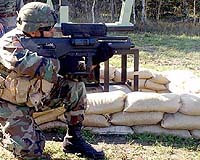
Grafenwohr, Germany (SPX) Oct 05, 2005 Soldiers with the 1st Infantry Division got a sneak peek at the Army's future when they fired three experimental weapons at Grafenwohr Training Area here. The new weapons are upgraded versions of a grenade launcher, a machine gun and a semi-automatic rifle. The systems are produced at Picatinny Arsenal, an Army installation in New Jersey. Army Lt. Col. Kevin Stoddard, project manager for crew-served weapons at Picatinny, said soldiers were getting a chance to fire "the next generation of soldier weapons." He said the weapons were built from the ground up with feedback from soldiers after each step. The final result was the weapons that were fired Sept. 24. With optical and thermal sights and little kickback, the weapons proved easy to fire, and most soldiers hit the targets on their first attempts. "These weapons allow soldiers to get their first round on target, quickly engage the enemy and move to the next target," Stoddard said. Army Spec. Jason Enriquez, an infantryman with B Company, 2nd Battalion, 2nd Infantry Regiment, was the first Soldier in the area to fire the XM25, a semiautomatic weapon. He had glowing reports on its capabilities. "It was totally smooth and light. It shot fantastic," he said. "It moves your head and snaps you back. I never felt a kick like that before, but it was smooth. It wasn't rough." The XM25 is equipped with a ballistic computer, thermal sights and zoom capabilities. Like Enriquez, Army Spec. Matthew Krupa also found the weapon easy to use. "The accuracy was amazing," Krupa said, a tanker with Headquarters and Headquarters Troop, 1st Battalion, 4th U.S. Cavalry Regiment. "The site was perfect, very advanced." Having the XM25 in Iraq would have proven beneficial, Krupa added. "It would be good for getting people behind walls or ducking behind cars. It would have helped a lot," he said. Also tested was the XM312 machine gun, which shoots, handles and maintains like a light machine gun. Army Spec. Jay Teller and others were amazed at both the accuracy and steadiness of the XM312. "It has a site, and it doesn't move much because there isn't much kick, so you can keep your eye right on the crosshairs," said Teller, who serves as a scout with C Troop, 1st Bn., 4th U.S. Cav. Rgt. "It's a very easy weapon to shoot." The ability to lay the first round on target is what impressed Teller the most. "It would have been very beneficial downrange. There's zero time for the bad guy to see what's going on," he said. That also means a more optimal use of ammunition, noted Army Spec. Jonathan Calvin, a fueler with Headquarters and Headquarters Company, 121st Signal Battalion. "It conserves a lot of rounds because of the accuracy. You would be able to hit your target every time," Calvin said. Also tested was the SM320, a low-velocity grenade launcher that either attaches to a host rifle or is fired as a stand-alone weapon. Although none of the Soldiers had used it before, most scored hits on their first try. Stoddard said he expects the fielding of these advanced weapons to begin in 2008. Community Email This Article Comment On This Article Related Links SpaceDaily Search SpaceDaily Subscribe To SpaceDaily Express The latest in Military Technology for the 21st century at SpaceWar.com
 Polish Defense Ministry Procures Elisra's EJAB For Its Forces In Iraq
 Bene-Berak, Israel (SPX) Jan 09, 2006
Elisra Electronic Systems, a member of The Elisra Group, has received an order estimated at $3 million from the Polish Ministry of Defense for its unique EJAB system. |
|
|

| The content herein, unless otherwise known to be public domain, are Copyright 1995-2006 - SpaceDaily.AFP and UPI Wire Stories are copyright Agence France-Presse and United Press International. ESA PortalReports are copyright European Space Agency. All NASA sourced material is public domain. Additionalcopyrights may apply in whole or part to other bona fide parties. Advertising does not imply endorsement,agreement or approval of any opinions, statements or information provided by SpaceDaily on any Web page published or hosted by SpaceDaily. Privacy Statement |