|
 |
 |
 |
 |
 |
 |
 |
 |

 |
US And Japan Sign Satellite Back-Up Agreement
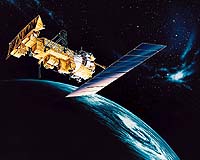
Washington DC (SPX) Mar 28, 2005 The National Oceanic and Atmospheric Administration have signed a long-term agreement with the Japan Meteorological Agency to guarantee continuous geostationary satellite coverage of the continental United States and the Western Pacific, in case either agency experiences a spacecraft failure. Under this agreement signed in Tokyo, NOAA and JMA agree to provide short-term geostationary back-up coverage in an emergency, and monitor typhoons and other severe weather that threaten both nations. If either a NOAA or JMA geostationary spacecraft stops operating, and has no available back-up satellite of its own, then the partner agency would temporarily move one of its satellites toward the appropriate region and provide coverage for up to one year - at no cost, allowing the other agency time to recover from the failure and launch a replacement spacecraft. "This cooperative agreement is critical to helping forecasters in the U.S. and Japan provide life-saving weather warnings, in the event a national satellite is unable to operate," said retired Vice Admiral Conrad C. Lautenbacher, Jr., Ph.D., undersecretary of commerce for oceans and atmosphere and NOAA administrator. He added: "A back-up satellite arrangement like this is also key to a strong Global Earth Observation System of Systems, because we will need to know what the environment is doing, despite the loss of a satellite." Under an existing agreement signed in 2003, NOAA's GOES-9 satellite has provided JMA with geostationary satellite coverage of the Western Pacific. GOES-9 has backed up JMA's Geostationary Meteorological Satellite (GMS-5), because it experienced imaging problems and fuel shortages. "The U.S., through NOAA, continues to take international satellite cooperation from concept to reality, as does Japan," said Gregory W. Withee, assistant administrator for NOAA's Satellite and Information Service. Withee signed the agreement for NOAA in Tokyo. "Weather and climate impacts everyone in the world, so we need to ensure the systems - and back ups for those systems - are in place for the benefit of all humanity." NOAA operates two GOES spacecraft, which drive the accuracy of forecasting short-range weather events, including tornadoes, floods, snow and rain storms and tropical cyclones. NOAA is dedicated to enhancing economic security and national safety through the prediction and research of weather and climate-related events and providing environmental stewardship of our nation's coastal and marine resources. Community Email This Article Comment On This Article Related Links NOAA's Satellite and Information Service SpaceDaily Search SpaceDaily Subscribe To SpaceDaily Express Earth Observation News - Suppiliers, Technology and Application
 Weatherman's Monsoon Talk Says It All In Agriculture-Dependent India
 Bangalore, India (AFP) Jun 05, 2005
Prashant Goswami at this time of year has farmers, government officials, global investors, stock market players and economists hanging on his every word -- provided he's making monsoon talk. |
|
|

| The content herein, unless otherwise known to be public domain, are Copyright 1995-2006 - SpaceDaily.AFP and UPI Wire Stories are copyright Agence France-Presse and United Press International. ESA PortalReports are copyright European Space Agency. All NASA sourced material is public domain. Additionalcopyrights may apply in whole or part to other bona fide parties. Advertising does not imply endorsement,agreement or approval of any opinions, statements or information provided by SpaceDaily on any Web page published or hosted by SpaceDaily. Privacy Statement |