|
 |
 |
 |
 |
 |
 |
 |
 |

 |
US And Australia Share New Communications Satellites
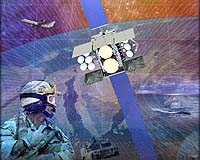
Washington DC (SPX) Nov 16, 2007 Representatives from the U.S. Air Force and the Royal Australian Air Force met at the Australian Embassy here to sign a memorandum of agreement that will provide both nations assured access to the Wideband Global SATCOM system, expanding the WGS constellation to six satellites. The expansion will vastly improve communications for the military forces of both countries with unprecedented access to bandwidth-intensive applications such as video streaming, teleconferencing, real-time data transmission and high-resolution imaging. "Today marks another great development in the U.S.-Australia partnership," said Bruce Lemkin, deputy undersecretary of the Air Force for international affairs. "Under this program, the next generation of communications satellites will come into operation with Australia as a participant with us. It's important not only for the capability, but It represents another strong bond in this great relationship between the U.S. and Australia." "We're now going to get a capability that neither of us would have had on our own," said the RAAF's Mark Reynolds, Counsellor Defence Material. "The sum of our parts is far greater than we could have imagined." Once operational, the WGS system will provide a quantum leap in communications bandwidth for the U.S. and Australian warfighters. It will be the Department of Defense's high capacity communications satellite in the X and Ka-band frequency range. In addition, the new wideband capability will offer support for the new generation of unmanned aerial vehicles, such as the RQ-4 Global Hawks and MQ-9 Reapers. "The Air Force saw a 'win-win' opportunity to partner with Australia to gain much needed additional capability while also satisfying Australia's (satellite communication) requirements," said Gary Payton, deputy undersecretary of the Air Force for space programs. The first WGS satellite is scheduled to achieve initial operational capability in January with full operational capability expected in 2013 following the launch of the sixth satellite. "When it comes online, Australia will have immediate access to it," Mr. Lemkin said. "It's mutually beneficial and provides a capability for both of our nations in carrying out each of our security responsibilities around the globe." Community Email This Article Comment On This Article Related Links Read the latest in Military Space Communications Technology at SpaceWar.com
 Northrop Grumman-Built Defense Support Program Flight 23 Satellite Successfully Launched
 Redondo Beach CA (SPX) Nov 12, 2007
The final Defense Support Program (DSP) satellite thundered into the night sky from Cape Canaveral Air Force Station on Nov. 10 at 8:50 p.m. EST, and successfully separated from the Delta IV-Heavy launch vehicle six hours and 20 minutes later. DSP was built by Northrop Grumman Corporation for the United States Air Force Space and Missile System Center. |
|
|

| The content herein, unless otherwise known to be public domain, are Copyright 1995-2007 - SpaceDaily.AFP and UPI Wire Stories are copyright Agence France-Presse and United Press International. ESA Portal Reports are copyright European Space Agency. All NASA sourced material is public domain. Additional copyrights may apply in whole or part to other bona fide parties. Advertising does not imply endorsement,agreement or approval of any opinions, statements or information provided by SpaceDaily on any Web page published or hosted by SpaceDaily. Privacy Statement |