|
 |
 |
 |
 |
 |
 |
 |
 |

 |
US Accepts New Term For UN Nuclear Chief
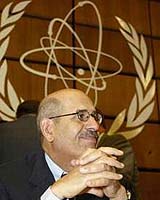
Washington (AFP) Jun 09, 2005 The United States on Thursday reversed its opposition to UN nuclear chief Mohamed ElBaradei and said it was ready to accept a third term for the Egyptian despite past policy disagreements. State Department spokesman Sean McCormack said Washington was ready to join other nations in supporting ElBaradei, who is the only candidate for director general of the International Atomic Energy Agency (IAEA). "We expect that when the vote comes up in the (IAEA) board of governors on this issue we will join the consensus," he said after ElBaradei held talks here with Secretary of State Condoleezza Rice. The IAEA board will choose a new head when it holds a regular meeting opening Monday at its headquarters in Vienna. Washington had resisted a new four-year term for ElBaradei, who had run the agency since 1997. The US administration and ElBaradei had clashed over the assessment of Iraq's weapons of mass destruction capabilities before the US invasion. The Americans also considered the IAEA chief too soft on Iran's nuclear program. But Washington appeared ready to at least try to bury the hatchet. "With respect to any alleged past disputes, we're looking forward and there is a lot of work to be done," McCormack said. "Based on the news reports that I see out there today, the vote, if held today, would have Dr. ElBaradai continuing at the IAEA and we would join such a consensus." ElBaradei made no comment to journalists here but his spokeswoman Melissa Fleming said in Vienna the United States had set no conditions on its support for a new term. The opposition of President George W. Bush's administration to the 62-year-old ElBaradei took the form of a reluctance to go beyond the usual two terms for a UN official. "We continue to believe that the two-term rule is an important principle within the UN. We believe it leads to a healthy UN system," McCormack said. But a State Department official, who asked not to be named, confirmed that while ElBaradei was not the Americans' choice for the post, he was the only candidate available. "You work with what you've got," the official said, adding that the United States would continue to press for a tougher line on Iran, which it suspects of using its civilian nuclear program to develop bombs. Rice and ElBaradei met for about half an hour, half of that one on one, and "focused primarily on strengthening the nuclear non-proliferation regime," McCormack said. He said they agreed on the need to boost inspections and, in an apparent reference to Iran, to take urgent steps to halt the spread of enrichment and reprocessing technology. ElBaradei irked the Americans by saying the "jury is still out" on whether Tehran was secretly developing nuclear weapons as alleged by Washington. But McCormack said that ElBaradei and IAEA staff were "working in a serious way" to curb Iran's suspected nuclear weapons ambitions. McCormack said the IAEA had a "central role" to play in seeing that Iran complied with its non-proliferation obligations and commitments to European negotiators to suspend sensitive nuclear activities. He also said there was "significant overlap" in the non-proliferation agendas outlined by Bush last year and some of ElBaradei's ideas. The Americans previously had taken no pains to mask their unease with ElBaradei. The Washington Post reported in December they tapped his telephone conversations with Iranian diplomats, seeking ammunition to oust him. But US officials looked increasingly resigned this week to his continued management of the IAEA in the absence of an alternative. Rice signaled Wednesday that Washington was ready to abandon its opposition. "We do have a long-held view that in general it is better that there be two terms for these positions," Rice told reporters after talks here with German Foreign Minister Joschka Fischer. "Nonetheless, we have worked well with Dr. ElBaradei in the past," she said, expressing an eagerness to discuss "his vision for what the IAEA will do in these next extremely important years." Fischer was less nuanced. "Our experiences in the cooperation with the IAEA, especially in the Iran issue, was excellent. So I have no reasons to complain," the German said. Community Email This Article Comment On This Article Related Links SpaceDaily Search SpaceDaily Subscribe To SpaceDaily Express Learn about nuclear weapons doctrine and defense at SpaceWar.com Learn about missile defense at SpaceWar.com All about missiles at SpaceWar.com Learn about the Superpowers of the 21st Century at SpaceWar.com
 World Powers Threaten Defiant Iran Over Nuclear Crisis
 Vienna (AFP) Jan 11, 2006
World powers threatened Iran with UN Security Council sanctions Wednesday after it resumed sensitive nuclear activities as a defiant Tehran vowed to press ahead with its disputed atomic programme. |
|
|

| The content herein, unless otherwise known to be public domain, are Copyright 1995-2006 - SpaceDaily.AFP and UPI Wire Stories are copyright Agence France-Presse and United Press International. ESA PortalReports are copyright European Space Agency. All NASA sourced material is public domain. Additionalcopyrights may apply in whole or part to other bona fide parties. Advertising does not imply endorsement,agreement or approval of any opinions, statements or information provided by SpaceDaily on any Web page published or hosted by SpaceDaily. Privacy Statement |