|
 |
 |
 |
 |
 |
 |
 |
 |

 |
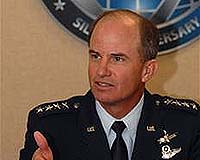
US AFSC General Speaks At AFA Conference
Washington DC (AFNS) Sep 26, 2007 General Kevin Chilton, Air Force Space Command commander, addressed hundreds of military members and civilians at the Air Force Association's Air and Space Conference and Technology Exposition Sept. 25. The general, nominated to become the head of U.S. Strategic Command, expounded on the history of Air Force space endeavors and what the future may hold for the nation's ventures into the final frontier. "It was decided early on that there is a synergy between Air Force rocket development and launching satellites," General Chilton, a former astronaut, pointed out. Although Space Command wasn't formally structured until 1982, the Air Force had been supporting the space mission since the end of World War II. "It was on Air Force rockets that the Mercury and Gemini missions were flown in the 1960s," General Chilton said. "In the 1970s we developed the principle of global vigilance, reach and power. And by the Gulf War in 1991, the (global positioning system) was revolutionary. "It illustrated the beauty and the power of Space Command," the general added. After talking about the history of AFSPC, General Chilton spoke about the promise and possibilities of the future for the command. He extolled the virtues of recapitalizing satellite systems that are already showing their worth. New systems that are already budgeted will improve GPS functions, missile warning and computer system bandwidth. He also described how the Air Force's space responsibilities affect everyone. "Nothing we do is just for the Air Force," General Chilton said. "We're a part of the joint fight and our space systems support the combatant commanders." In addition, the general took questions from the audience that ranged from creating a separate space service ("There are great synergies in working together and not creating a specific space force") to the use of kinetic weapons against satellites ("The last thing we need is to create more debris up there"). Overall, General Chilton said that Space Command is an important part of the Air Force mission. "From the very beginning, we've been the 'cutting edge technology' service," General Chilton said. "It's our continued responsibility to operate in space." Community Email This Article Comment On This Article Related Links Military Space News at SpaceWar.com
 ATK Delivers TacSat-3 Spacecraft Bus For Integration And Test By The USAF Research Lab
 Minneapolis MN (SPX) Sep 20, 2007
Alliant Techsystems announced that it has delivered the Department of Defense's Tactical Satellite 3 Spacecraft Bus (TacSat-3) to the U.S. Air Force Research Laboratory (AFRL) for final integration and test. The TacSat-3 spacecraft is a pioneer of the emerging operationally responsive space (ORS) program, and designed to meet the needs of U.S. forces for flexible, affordable and responsive satellite systems. The TacSat-3 program is a joint effort of the Army Space and Missile Defense Command, Air Force Space Command, the Department of Defense's (DOD) Operationally Responsive Space Office (ORS), the Office of Naval Research (ONR) and the Air Force Research Laboratory's Space Vehicles Directorate. |
|
|

| The content herein, unless otherwise known to be public domain, are Copyright 1995-2007 - SpaceDaily.AFP and UPI Wire Stories are copyright Agence France-Presse and United Press International. ESA Portal Reports are copyright European Space Agency. All NASA sourced material is public domain. Additional copyrights may apply in whole or part to other bona fide parties. Advertising does not imply endorsement,agreement or approval of any opinions, statements or information provided by SpaceDaily on any Web page published or hosted by SpaceDaily. Privacy Statement |