
 |
 |
 |
 |
 |
 |
 |
 |
 |

 |

Paris (AFP) Dec 20, 2010 The United Nations set the cornerstone Monday for an ultimate scientific authority on biodiversity to help protect ecosystems and stem the planet's dramatic loss of animal and plant life. Modelled on the UN's climate change panel (IPCC), the Intergovernmental Platform on Biodiversity and Ecosystem Services, or IPBES, will harness the expertise of thousands of scientists worldwide. "The IPCC shows how crucial it is to have a coherent scientific view of something as complex as climate or biodiversity," said Lucien Chabason, a researcher at the Institute for Sustainable Development and International Relations in Paris. "We urgently need to close the gap between policy making and science," he told AFP. Some experts say eroding ecosystems and dwindling biodiversity pose as great a threat to life on Earth -- including human life -- as climate change. Whether due to habitat loss and pollution, or indirectly through global warming and the spread of invasive species, humans are squarely to blame for what may be the first major die-off since the dinosaurs disappeared, they say. "There have been five major episodes of extinction over the last 500 million years, and there are many indications that we have entered a sixth," said Chabason. The current die-off pace is 100 to 1,000 times higher than average. A fifth of mammals, 30 percent of amphibians, 12 percent of known birds, and more than a quarter of reef-building corals -- upon which half-a-billion people depend for livelihood -- face extinction, are threatened. The IPBES will also quantify damage inflicted on life-sustaining ecosystems long taken for granted, from depleted water tables to deracinated mangroves to rivers and air poisoned by pesticides and pollution. "It will allow scientists around the globe to address key questions facing governments on the relation between biodiversity and economic development," said Salavatore Arico, an expert at UNESCO. IPBES was five years in gestation, and survived a gauntlet of obstacles and objections. The United States was leery of the constraints and budgetary burden that come with creating an new international body, while China expressed strong skepticism, said Chabason, who attended key meetings. So-called "mega-diverse" countries, notably Brazil, feared the panel might serve as a wedge for commercial exploitation of its hugely rich store of flora and fauna. But doubts were overcome, and IPBES was approved in principle by nearly 90 nations in South Korea in June. The idea nudged closer to reality in October at a meeting in Nagoya, Japan of the UN Convention on Biodiversity. While explicitly modelled on IPCC, there are some key differences. Chabason said there were lessons to be learned from the storm of controversy that engulfed the climate panel after mistakes were uncovered in its most recent report, issued in 2007. "The errors were not in the scientific findings, but in the scenarios for the future, and scenarios for biodiversity will be even more difficult to construct," he said. Also, unlike the IPCC, the IPBES is mandated to directly help developing countries, especially in Africa, build up their capacity for scientific monitoring and evaluation.
Share This Article With Planet Earth
Related Links Darwin Today At TerraDaily.com

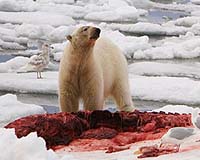 Polar Bears Extinction Can Be Averted
Washington DC (SPX) Dec 16, 2010 Polar bears were added to the threatened species list nearly three years ago when their icy habitat showed steady, precipitous decline because of a warming climate. But it appears the Arctic icons aren't necessarily doomed after all, according to results of a study published in this week's issue of the journal Nature. The findings indicate that there is no "tipping point" that would ... read more |
|
|
| The content herein, unless otherwise known to be public domain, are Copyright 1995-2010 - SpaceDaily. AFP and UPI Wire Stories are copyright Agence France-Presse and United Press International. ESA Portal Reports are copyright European Space Agency. All NASA sourced material is public domain. Additional copyrights may apply in whole or part to other bona fide parties. Advertising does not imply endorsement,agreement or approval of any opinions, statements or information provided by SpaceDaily on any Web page published or hosted by SpaceDaily. Privacy Statement |


 del.icio.us
 Digg
Digg Reddit
 YahooMyWeb
 Google
 Facebook


