|
 |
 |
 |
 |
 |
 |
 |
 |

 |
UN Launches Campaign For Disaster-Proof Schools
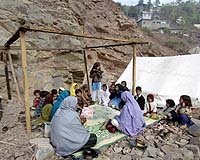
Geneva (AFP) Jun 16, 2006 The United Nations kicked off a new campaign Thursday aiming to reduce the impact on children of disasters like the Asian tsunami, the earthquake in Kashmir or the mudslide which wiped out a school in the Philippines. The goal of the two-year programme -- run jointly with the Red Cross and the relief group Action Aid -- is to encourage governments to construct schools that can withstand natural catastrophes, as well as raise youngsters' awareness of the risks and how to react. "More than 200 million people are affected every year by disasters, and children under 18 are the most vulnerable group, especially those attending schools at the time of the catastrophe," said Salvano Briceno, head of the UN's International Strategy for Disaster Reduction. "Roughly one billion children aged up to 14 years live in countries with high seismic risks, which puts several hundred million children at risk while they are attending schools," he told journalists. Last year's Kashmir earthquake killed more than 75,000 people and displaced 3.5 million others. Some 16,000 of the victims were Pakistani youngsters who died in schools that collapsed, noted Briceno. Last February, a massive mudslide on the Philippine island of Leyte buried more than a thousand people, including more than 200 children in a school. "These are just a few tragic examples of why more needs to be done to protect children," said Briceno. The campaign will spotlight best practices around the world and encourage policymakers in other countries to follow them, as well as getting childen, parents, teachers and community leaders involved. In addition to building new disaster-proof schools -- which adds an average 10 percent to construction costs -- officials should also consider refurbishing exsiting buildings to protect youngsters, said Briceno. In addition, he said, risk education should be made a standard part of the school curriculum. "Children need to become aware how to identify risks that are around them. They have to be sensitive to how their houses are built, where their houses are located, where their schools are located and how they are built," said Briceno. "Becoming aware of risks means they can do something about it." Such teaching is not only important in catastrophe-prone countries, said Briceno, noting the impact on foreign tourists of the Asian tsunami in December 2004. That disaster claimed 217,000 lives around the Indian Ocean, including hundreds of tourists. Knowing what to do could have saved many people, locals and visitors alike, said Briceno. He pointed to the example of a young British girl, Tilly Smith, who had studied tsumanis in a geography class two weeks before holidaying in Thailand and so recognised the signs of the looming disaster. She was credited with saving her family and at least 100 others after she raised the alarm. "The only way we can reduce the number of victims and the negative impact of disasters is when every individual is aware and knows what to do," said Briceno.
Source: Agence France-Presse Community Email This Article Comment On This Article Related Links - Bringing Order To A World Of Disasters A world of storm and tempest When the Earth Quakes
 Hurricane Damage Mininized By Sticking To The Rules
 Gaithersburg MD (SPX) Jun 15, 2006
Stricter adherence to existing building standards, model building codes and good building practices, and a greater recognition of the risks posed by storm surge, could minimize the kind of structural damage experienced in the Gulf Coast states hit by Hurricanes Katrina and Rita last year, the National Institute of Standards and Technology (NIST) announced on June 9, 2006. |
|
|

| The content herein, unless otherwise known to be public domain, are Copyright 1995-2006 - SpaceDaily.AFP and UPI Wire Stories are copyright Agence France-Presse and United Press International. ESA PortalReports are copyright European Space Agency. All NASA sourced material is public domain. Additionalcopyrights may apply in whole or part to other bona fide parties. Advertising does not imply endorsement,agreement or approval of any opinions, statements or information provided by SpaceDaily on any Web page published or hosted by SpaceDaily. Privacy Statement |