|
 |
 |
 |
 |
 |
 |
 |
 |

 |
UNH Scientists Report First Findings On Key Astrophysics Problem
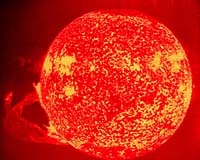
Durham NH (SPX) Nov 29, 2007 In a paper published recently in the journal Nature Physics, an international team of space scientists led by researchers from the University of New Hampshire present findings on the first experimental evidence that points in a new direction toward the solution of a longstanding, central problem of plasma astrophysics and space physics. The mystery involves electron acceleration during magnetic explosions that occur, for example, in solar flares and "substorms" in the Earth's magnetosphere - the comet-shaped protective sheath that surrounds the planet and where brilliant auroras occur. During solar flares, accelerated electrons take away up to 50 percent of the total released flare energy. How so many electrons are accelerated to such high energies during these explosive events in our local part of the universe has remained unexplained. A mainstream theory holds that the mysterious, fast-moving electrons are primarily accelerated at the magnetic explosion site - called the reconnection layer - where the magnetic fields are annihilated and the magnetic energy is rapidly released. However, physicist Li-Jen Chen of the Space Science Center within the UNH Institute for the Study of Earth, Oceans, and Space discovered that the most powerful electron acceleration occurs in the regions between adjacent reconnection layers, in structures called magnetic islands. When Chen analyzed 2001 data from the four-spacecraft Cluster satellite mission, which has been studying various aspects of Earth's magnetosphere, she found a series of reconnection layers and islands that were formed due to magnetic reconnection. "Our research demonstrates for the first time that energetic electrons are found most abundantly at sites of compressed density within islands," reports Chen. Another recent theory, published in the journal Nature, has suggested that "contracting magnetic islands" provide a mechanism for electron acceleration. While the theory appears relevant, it needs to be developed further and tested by computer simulations and experiments, according to the UNH authors. Until the UNH discovery there had been no evidence showing any association between energetic electrons and magnetic islands. This lack of data is likely due to the fact that encounters of spacecraft with active magnetic explosion sites are rare and, if they do occur, there is insufficient time resolution of the data to resolve island structures. In the Nature Physics paper, entitled "Observation of energetic electrons within magnetic islands," lead author Chen reports the first experimental evidence for the one-to-one correspondence between multiple magnetic islands and energetic electron bursts during reconnection in the Earth's magnetosphere. "Our study is an important step towards solving the mystery of electron acceleration during magnetic reconnection and points out a clear path for future progress to be made," says Chen. UNH collaborators on the paper include Amitava Bhattacharjee, Pamela Puhl-Quinn, Hong-ang Yang, and Naoki Bessho. Community Email This Article Comment On This Article Related Links University of New Hampshire Understanding Time and Space
 Texas A And M Researchers Examine Einstein's Theories On The Universe
 College Station TX (SPX) Nov 28, 2007
Einstein�s self-proclaimed �biggest blunder� � his postulation of a cosmological constant (a force that opposes gravity and keeps the universe from collapsing) � may not be such a blunder after all, according to the research of an international team of scientists that includes two Texas A and M University researchers. |
|
|

| The content herein, unless otherwise known to be public domain, are Copyright 1995-2007 - SpaceDaily.AFP and UPI Wire Stories are copyright Agence France-Presse and United Press International. ESA Portal Reports are copyright European Space Agency. All NASA sourced material is public domain. Additional copyrights may apply in whole or part to other bona fide parties. Advertising does not imply endorsement,agreement or approval of any opinions, statements or information provided by SpaceDaily on any Web page published or hosted by SpaceDaily. Privacy Statement |