|
 |
 |
 |
 |
 |
 |
 |
 |

 |
UK Astronomers Look Forward To Looking Back
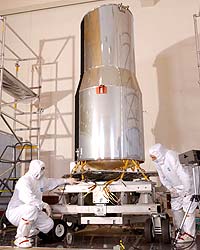
London - Aug 20, 2003 When NASA launches its Space Infrared Telescope Facility (SIRTF) - the agency's fourth 'Great Observatory' - later this week, astronomers around the world will be looking forward to using one of the most powerful time machines ever built. Among those anticipating the opportunity to look back billions of years to an era when the universe was in its youth are Professor Michael Rowan- Robinson (Imperial College London) and Dr. Sebastian Oliver (University of Sussex), who will be participating in the international SIRTF Wide-area InfraRed Extragalactic (SWIRE) survey. Taking advantage of SIRTF's ability to detect infrared radiation (heat) from the coolest objects in the universe, the SWIRE team will study galaxies located up to 10 billion light years away where infant stars are beginning to emerge from the dust clouds in which they were born. Over a period of nine months, the SWIRE survey will observe seven areas of the sky covering a total of 65 square degrees - equivalent to the area taken up by 360 full moons. These areas have been carefully selected because they are exceptionally transparent due to an absence of Galactic dust. Using all 7 SIRTF wavebands (3.6, 4.5, 5.8, 8, 24, 70 and 160 microns), SWIRE is expected to detect more than 1 million infrared galaxies, many of them dusty, star-forming galaxies that existed when the universe was only about three billion years old. "We shall be studying star-forming galaxies and quasars at high redshifts, looking far deeper in the infrared than any previous survey," said Professor Rowan-Robinson, Deputy Principal Investigator for the SWIRE programme. "By looking back through almost 90% of the universe's history, we shall be able to look back to a period when star formation was much more frequent than it is today," he added. "This will enable us to trace the evolution of star formation from very early times." "This is the most exciting and the most important project I have ever been involved with," said Sebastian Oliver, a SWIRE Co-Investigator. "Our infrared survey will be combined with studies by ground-based telescopes (such as the UK Infrared Telescope in Hawaii) and by orbiting observatories, such as the Hubble Space Telescope, Chandra and XMM-Newton, that study the universe at other wavelengths." "The SWIRE survey will provide our first glimpse of many distant galaxies," he added. "Long ago, galaxies were much closer together, and we think that colliding galaxies triggered periods of rapid star birth and quasar activity. We expect to see thousands of colliding galaxies in the ancient universe, and this will help us to explain how galaxies grew and evolved." The SWIRE team is led by Dr. Carol Lonsdale at the Infrared Processing and Analysis Center, California Institute of Technology. SWIRE is the largest of the 6 major 'Legacy' observational programmes being undertaken with SIRTF. These projects utilise a total of 3160 hours of SIRTF observing time, primarily in the first year of the mission, and integrate substantial ancillary data from ground-based observatories and other space-borne telescopes. A Boeing Delta 2 rocket carrying SIRTF is currently scheduled for launch from Cape Canaveral, Florida on August 23 at 05:37 GMT (06:37 BST). SIRTF is the fourth and last of NASA's Great Observatories. Two of these, the Hubble Space Telescope and the Chandra X-ray Observatory are currently operational. The Compton Gamma Ray Observatory re-entered Earth's atmosphere on 4 June 2000. Originally intended as a $2 billion observatory that would be launched by the space shuttle, SIRTF has suffered prolonged delays as the result of downsizing and redesign of the spacecraft. The new observatory is still the largest, most sensitive infrared space observatory ever built, although its mirror is 'only' 85 cm (33 inches) in diameter, much smaller than the Hubble Space Telescope or modern ground- based telescopes. It carries three cryogenically cooled instruments incorporating state-of-the-art infrared detectors. The telescope will be cooled to a temperature of -268 C (only 5.2 C above absolute zero) by a tank containing 360 litres of liquid helium. SIRTF is expected to operate for at least two-and-a-half years, with a goal of five years. Some of its detectors will be able to operate even after the supply of helium runs out. Following launch, the spacecraft will drift slowly away from our planet into deep space, receding from us at a rate of about 9 million miles per year. By following this remote, Earth-trailing orbit, heat 'pollution' from the Earth and Moon will be reduced. Observations will also be made easier because the Earth will not be blocking the view and there will be no periods in the planet's shadow. The mission is a cornerstone of NASA's Origins Programme, which seeks to answer the questions "Where did we come from? Are we alone?" Observing at infrared wavelengths between 3 and 180 microns, SIRTF will be able to study the coolest objects in the universe and probe the dense dust clouds that block visible light. The four main areas of study will be: Brown dwarfs (small, failed stars) and giant gas planets around other stars; The discovery and study of debris disks around nearby stars; Ultraluminous infrared galaxies and quasars; The early universe - when and how the first stars and galaxies formed. UK astronomers are currently helping to develop a much larger infrared telescope, known as Herschel, which will be launched by the European Space Agency in 2007. Infrared radiation was discovered in 1800 by the German-born British astronomer, William Herschel. Community Email This Article Comment On This Article Related Links SIRTF Imperial College London Sussex University ESA Herschel mission ESA brochure 'The Infrared Universe' RAS SpaceDaily Search SpaceDaily Subscribe To SpaceDaily Express Space Telescope News and Technology at Skynightly.com
 Cornell's Contract For Management Of Arecibo Observatory Renewed
 Ithaca NY (SPX) Apr 06, 2005
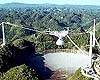
The National Science Foundation (NSF) has renewed Cornell University's management contract for the operation of Arecibo Observatory, the world's largest and most-sensitive single-dish radio/radar telescope.
--------------------------------------------------------- It's new. And it's downright terrific! Celestron's CPC Schmidt-Cassegrain telescope is the scope you've been waiting for! It offers new alignment technology, advanced engineering, and bold new design at a new, low price! In fact, Celestron's Professional Computerized (CPC) scope with revolutionary SkyAlign Alignment Technology redefines everything that amateur astronomers are looking for. It offers quick and simple alignment, GPS technology, unsurpassed optical quality, ease of use, advanced ergonomics, enhanced computerization and, most important, affordability. Want to view M-31 tonight? One button takes you there!
Shop for telescopes online at Telescopes.com! today!
|
|
|

| The content herein, unless otherwise known to be public domain, are Copyright 1995-2006 - SpaceDaily.AFP and UPI Wire Stories are copyright Agence France-Presse and United Press International. ESA PortalReports are copyright European Space Agency. All NASA sourced material is public domain. Additionalcopyrights may apply in whole or part to other bona fide parties. Advertising does not imply endorsement,agreement or approval of any opinions, statements or information provided by SpaceDaily on any Web page published or hosted by SpaceDaily. Privacy Statement |