|
 |
 |
 |
 |
 |
 |
 |
 |

 |
UF Team Demonstrate On-Chip Antenna
Gainesville (SPX) May 13, 2004 Like the signals it emits, the radio may soon disappear from sight. University of Florida electrical engineers have installed a radio antenna less than one-tenth of an inch long on a computer chip and demonstrated that it can send and receive signals across a room. The achievement is another step in the team's continuing efforts to build an "ultrasmall radio chip" � a transceiver, processor and battery all placed on a chip not much larger than a pinhead � and one that could one day be used for applications ranging from detecting illegal border crossing to ensuring bridge and tunnel safety. "This project is about building very small radios that are very hard to detect, both electrically and physically," said Ken O, a UF professor of electrical and computer engineering and one of six authors of an article reported in last month's edition of Electrical and Electronics Engineering Electron Device Letters. "Since the antenna is usually the biggest part of the radio, this is a significant step." Tiny, cheap and disposable radios are seen as having many applications � and not for dialing in tunes from BB-sized Walkmans. Instead, the goal is to pair the radios with equally tiny, inexpensive sensors as a way of saturating large areas with sensing and communication capabilities. O said other researchers have suggested, for example, that airplanes could drop radio-motion detectors by the hundreds of thousands along borders, creating an electronic eavesdropping "fence" that would alert authorities to anyone crossing the border illegally. Each radio would be powerful enough to transmit information to the next radio, creating a single large network that could be monitored from afar. "Instead of building fences, you could just deploy these things (radio sensors)," O said. Another potential application: Pairing the radios with force or strain sensors implanted throughout bridges, dams or tunnels, with the goal of reporting small defects before they mushroom into disastrous problems. Equipped with microphones, the radios also could make excellent covert listening devices, because they are so tiny and their individual signals so weak that they are difficult to detect both by with the naked eye and electronically, O said. Joe Brewer, a UF professor of electrical and computer engineering and member of the research team, said other possible applications include using the tiny radio "nodes" in place of heavy wiring in aircraft and spacecraft, which need to be as light as possible. The nodes could also be used in factories to monitor the progress of items as they progress down the line. "We're not at the stage where we're really working on the details or applications � what we're trying to do is create the basic capability," he said. Some groups have sought to achieve such communication networks using tiny optical devices, but this approach has difficulty of aiming the information-carrying light from one optical device to another, O said. In research sponsored by the Semiconductor Research Corp. and the Defense Advanced Research Projects Agency, or DARPA, the UF group has made steady progress on true single chip radios. Two years ago, the group announced it had achieved radio communication across a single fingernail-sized chip. The current research significantly extends the communication range to at least 16 feet in free space, O said. Brewer said the chief importance of the latest research is that it changes some of the traditional "ground rules" governing ultrasmall radio design � namely that the antenna has to be a separate unit from the rest of the on-chip radio. "The impact here is that the problem of taking radio frequency signals from an antenna through electrical connections in wires to get it to a chip has always been difficult, and this (the latest research) eliminates an interface," he said. "It makes the whole assembly much more rugged." The next step in creating the tiny radios will be to miniaturize the crystal oscillator that tunes into the radio frequency, O said. The eventual goal is to produce radios that cost less than $1 each, O said. Community Email This Article Comment On This Article Related Links University of Florida SpaceDaily Search SpaceDaily Subscribe To SpaceDaily Express Space Technology News - Applications and Research
 Industry Team Achieve New Communications Technology With AESA Radars
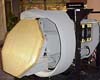 Baltimore MD (SPX) Jan 12, 2006
A team comprised of three leading US aerospace and defense contractors has demonstrated an innovative technological use of active electronically scanned array (AESA) radars for high-bandwidth communications. |
|
|

| The content herein, unless otherwise known to be public domain, are Copyright 1995-2006 - SpaceDaily.AFP and UPI Wire Stories are copyright Agence France-Presse and United Press International. ESA PortalReports are copyright European Space Agency. All NASA sourced material is public domain. Additionalcopyrights may apply in whole or part to other bona fide parties. Advertising does not imply endorsement,agreement or approval of any opinions, statements or information provided by SpaceDaily on any Web page published or hosted by SpaceDaily. Privacy Statement |