|
 |
 |
 |
 |
 |
 |
 |
 |

 |
UCLA Geophysicist Warns 6.4 Quake To Hit LA By Sept 5'
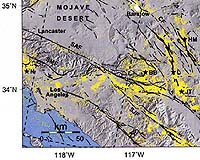
Los Angeles - Apr 15, 2004 A US geophysicist has set the scientific world ablaze by claiming to have cracked a holy grail: accurate earthquake prediction, and warning that a big one will hit southern California by Sept 5. Russian-born University of California at Los Angeles (UCLA) professor Vladimir Keilis-Borok says he can foresee major quakes by tracking minor temblors and historical patterns in seismic hotspots that could indicate more violent shaking is on the way. And he has made a chilling prediction that a quake measuring at least 6.4 magnitude on the Richter scale will hit a 31,200-square-kilometre area of southern California by September 5. The team at UCLA's Institute of Geophysics and Planetary Physics accurately predicted a 6.5-magnitude quake in central California last December as well as an 8.1-magnitude temblor that struck the Japanese island of Hokkaido in September. "Earthquake prediction is called the Holy Grail of earthquake science, and has been considered impossible by many scientists," said Keilis-Borok, 82. "It is not impossible. "We have made a major breakthrough, discovering the possibility of making predictions months ahead of time, instead of years, as in previously known methods." If accurate, the prediction method would be critical in an area like California, which is criss-crossed by fault lines that have spawned devastating quakes over the years including ones which ravaged San Francisco in 1989 and Los Angeles in 1994. That has given credence to his research, which was endorsed by a state panel, the California Earthquake Prediction Evaluation Council, earlier this month. "Even two years back it was practically a dirty word to say earthquake prediction," said Nancy Sauer, an organiser of the annual conference of the Seismological Society of America which began yesterday in Palm Springs. The UCLA team - made up of US, Japanese, Canadian, European and Russian experts in pattern recognition, geodynamics, seismology, chaos theory, statistical physics and public safety - says it has developed algorithms to detect earthquake patterns. The experts predicted in June an earthquake measuring 6.4 or higher would strike within nine months in a 496-kilometre region of central California, including San Simeon, where a 6.5-magnitude temblor struck December 22, killing two people. In July, they said they predicted a magnitude 7.0 or higher quake in a region that included Hokkaido by December 28. The September 25 quake fell within that period. Now they predict a major quake will hit an area that stretches across desert regions to the east of Los Angeles, home to around nine million people, including the Mojave desert and the resort town of Palm Springs, which lies near the notorious San Andreas fault. That is where experts began gathering for the Seismological Society of America conference that looks sure to be dominated by passionate discussion of Keilis-Borok's prediction method. "There is something going on," Sauer told the Desert Sun newspaper in Palm Springs. "People are at least willing to entertain the idea. It is not seen so much as junk science now." Another seismic expert, University of Oregon professor Ray Weldon, was scheduled to present findings to the conference that appear to support Keilis-Borok's research by saying the San Andreas fault is about to enter a new and violent period of shaking. The data, according to the Desert Sun, was gathered over 18 years around the famed fault, showing it is under high levels of stress. "You could consider that support (for Keilis-Borok's research)," Weldon was quoted as saying. "But I dont lend any insight or support to a window of time." But researchers still point to the fact that the science of earthquake prediction has been notoriously inaccurate and the geographic area targeted by the UCLA team for an imminent quake is very large. "It is not specific," said Susan Hough, a seismologist for the US Geological Survey based in Pasadena, near Los Angeles. "They've made three predictions and two of them have been borne out." Keilis-Borok himself acknowledged the caution expressed by some of his colleagues. "Application of non-linear dynamics and chaos theory is often counter-intuitive, so acceptance by some research teams will take time." But if his latest prediction that the earth will move in the area around Los Angeles within the next five months proves accurate, his research could end up saving lives and transforming seismology.
Community Email This Article Comment On This Article Related Links SpaceDaily Search SpaceDaily Subscribe To SpaceDaily Express Tectonic Science and News
 Ash Continuing To Spew From Vanuatu Volcano
 Sydney (AFP) Dec 12, 2005
Thousands of tonnes of ash are continuing to spew from a volcano in Vanuatu, but officials said Monday the activity on the South Pacific nation was not likely to result in a major deadly eruption. |
|
|

| The content herein, unless otherwise known to be public domain, are Copyright 1995-2006 - SpaceDaily.AFP and UPI Wire Stories are copyright Agence France-Presse and United Press International. ESA PortalReports are copyright European Space Agency. All NASA sourced material is public domain. Additionalcopyrights may apply in whole or part to other bona fide parties. Advertising does not imply endorsement,agreement or approval of any opinions, statements or information provided by SpaceDaily on any Web page published or hosted by SpaceDaily. Privacy Statement |