
 |
 |
 |
 |
 |
 |
 |
 |
 |

 |
UCF Project Selected For NASA Explorer Mission
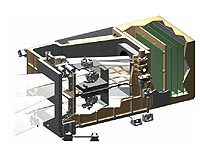
Orlando, FL (SPX) Jul 15, 2008 NASA last week selected a University of Central Florida project that will measure the temperature and make-up of the Earth's outer atmosphere as one of two missions of opportunity under its Explorer science space program. The Global-Scale Observations of the Limb and Disk (GOLD) project led by UCF Physicist Richard Eastes will build and fly a special camera known as an imaging spectrograph to record images of ultraviolet light emitted by the atmosphere approximately 62 miles above the Earth's surface. The data are important because they help predict space weather. Space weather impacts electrical systems on the ground and disrupts satellites orbiting the earth. Businesses and consumers have come to rely more and more on satellites, which are essential for cell phone, television and GPS navigation systems. GOLD will be able to measure from a satellite orbiting in sync with the earth, meaning the data can be collected across an entire hemisphere throughout the day. Eastes, who conducts his research at UCF's Florida Space Institute at Kennedy Space Center, has focused on GOLD for the last three years. While he serves as the scientific lead on the project, researchers from UCF's Center for Research and Education in Optics and Lasers (CREOL) and the School of Electrical Engineering and Computer Science have developed the hardware and optics required for the mission and will process the data from the spectrograph. A University of Colorado team will build the camera, which is expected to be the size of a breadbox, and collect the data. "It was necessary to make a convincing case that we could build the instrument, get it into orbit, and use the data for important new science," Eastes said. He added that one of the key factors in UCF's securing the project was the team's ability to secure a commercial satellite to carry the camera, about the size of a breadbox, into space. "There has never been a NASA science instrument flown on a commercial communications satellite," he said. NASA's Explorer program is designed to provide frequent, low-cost access to space for physics missions with small to mid-sized spacecraft. More than 70 U.S. and cooperative missions have been launched under the program since it was established in 1958. The GOLD project was one of two missions of opportunity selected from 17 applicants. The other project will provide an instrument for the Japan Aerospace Exploration Agency's New exploration X-Ray telescope to study black holes and extreme environments in the universe. Eastes and his team will initially receive $250,000 to develop a concept study by the end of the year. UCF's team members include: Professors James Harvey of CREOL; Hassan Foroosh, Jun Wang and Huiyang Zhou from the School of Electrical Engineering and Computer Science; and Andrey Krywonos, a recent Ph.D. graduate from CREOL. Community Email This Article Comment On This Article Share This Article With Planet Earth
Related Links The University of Central Florida Space Tourism, Space Transport and Space Exploration News
 House Passes S And T Bills Commemorating NASA's 50th Anniversary, First Woman In Space
 Washington DC (SPX) Jul 11, 2008
The House of Representatives has passed bills commemorating the 50th Anniversary of the National Aeronautics and Space Administration (NASA), and honoring the first American woman to go into space. |
|
|

| The content herein, unless otherwise known to be public domain, are Copyright 1995-2007 - SpaceDaily.AFP and UPI Wire Stories are copyright Agence France-Presse and United Press International. ESA Portal Reports are copyright European Space Agency. All NASA sourced material is public domain. Additional copyrights may apply in whole or part to other bona fide parties. Advertising does not imply endorsement,agreement or approval of any opinions, statements or information provided by SpaceDaily on any Web page published or hosted by SpaceDaily. Privacy Statement |
 del.icio.us
 Digg
Digg Reddit
 YahooMyWeb
 Google
 Facebook